A TV frame for someone else's photo
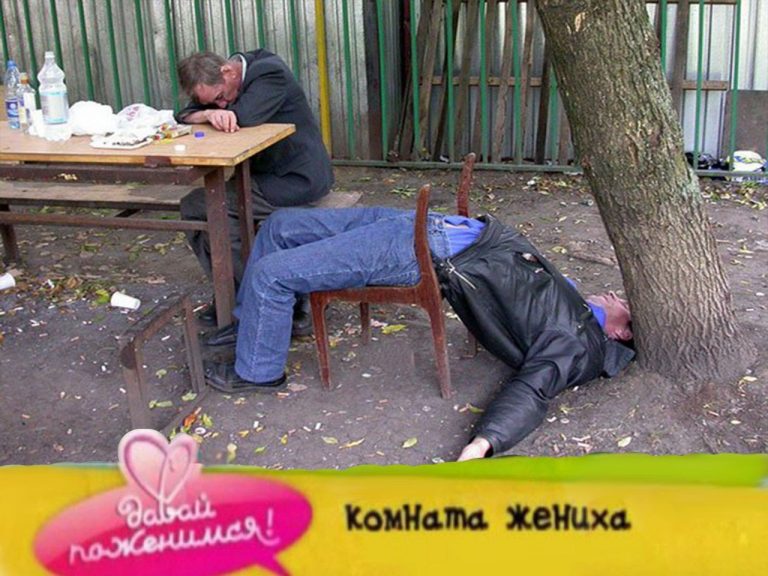
At the bottom of the picture runs a yellow strip with black lettering: “Groom's Room.” On the left is the pink “Let's Get Married!” logo with hearts. Above the strip is a yard: at a wooden table a man has laid his head on his arms, while another lies on his back on the ground by a tree, with his feet resting on an overturned chair. On the table stand bottles and assorted items; a fence stands behind. The TV graphics make this informal scene resemble an insert from a program.
The word “room” here collides with open space: instead of a studio interior, the viewer is shown a tree, dirt and street furniture. The reasons for the poses and the names of the men in the photo are unclear. The meme creates its own explanation only through the added frame, which invites us to imagine them as the groom's company. This substitution is especially noticeable thanks to the recognizable logo: a small strip at the bottom changes the genre of the entire image without requiring complex editing or additional characters.
From companions' rooms to the May wave
“Let's Get Married!” first aired on Channel One in 2008. In the show, the hero meets potential partners and chooses whom they would like to continue a relationship with. Participants have companions — friends or relatives who are shown in separate rooms. The captions help the viewer understand whose side a particular group represents. The TV plate therefore has a clear function: to name the person's surroundings while the acquaintance itself takes place in another part of the studio.
In May 2018, versions with this graphic became noticeable on VKontakte. Instead of the usual room image, authors substituted game scenes, unusual companies and photos of household mess. There were also versions with a bride's room. No single established author of the whole format is known: the recognizable television element allowed many people to assemble their own collages. This particular street photo is one variant of the game, not a documentary account of the show's participants.
The surroundings replace the questionnaire
The joke invites us to judge an imaginary groom by what surrounds him. On television, a room may be shown for the sake of relatives' reactions, while the meme uses it as a brief characterization of habits. Instead of a long acquaintance, the viewer gets one scene, which they mentally link with the person. The further it is from a tidy studio setting and a conversation about relationships, the more noticeable the comic gap between the official presentation and the unexpected contents.
A groom among board game boxes
In the first invented collage, above the yellow strip is a room where a table and armchairs are taken up by board game boxes, and the only free spot is between two stacks of rulebooks. The caption remains the same — “Groom's Room” — although the room immediately makes clear what the supposed groom does and why guests find it hard to sit down. The strip's text itself sounds perfectly calm, as if this were an ordinary television insert, and no one treats the room's oddity as a reason to change the program's official tone.
A room taken over by cats
In the second invented version, instead of friends, three cats sit in the frame: one occupies an armchair, another lies on a folder, and the third looks into the camera. The caption is still “Groom's Room,” and the viewer comes up with their own idea of what place these animals hold in his life. The comedy is built on replacing the expected group of companions with very serious feline advice. Unlike the street scene with men, the new collage conveys a different characteristic of the hero while keeping the same way of presenting it through the TV frame.