Plot
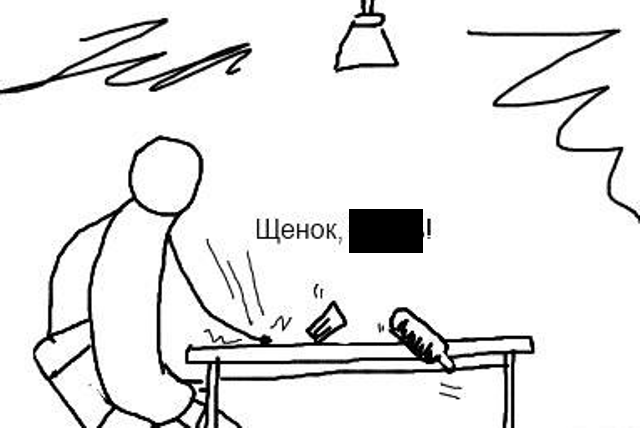
“Puppy” is a meme based on a black-and-white comic in the style of simple drawn stories. The plot consists of four panels: a father wants to talk to his son or teach him something, the son refuses, and the father, left at the table, drinks and bangs his fist, saying the word “puppy” followed by a vulgar curse word.
The comedy rests on the abrupt shift from a domestic situation to an absurd ending. The curse word in the final beat cuts the scene short, and the phrase “Puppy” itself becomes a standalone quote that is easy to lift out of context and use as a signal of an absurd or unexpected turn.
Image attached to the entry
The illustration in the entry shows a single panel of such a comic: an outlined figure of a man sitting at a table, a few objects on the table, and strokes above his head indicating motion. The speech bubble reads “Puppy,” then a word covered by a black rectangle, and an exclamation mark.
There is a discrepancy here: the comic has four panels, while the illustration shows only one. The picture also does not show the character drinking or banging his fist.
Origin
The origin of the meme is not established. It is not known who the comic's author is, on which platform it first appeared, or exactly when it emerged. The meme dates to 2012.
Black-and-white comics about generational conflicts are common in the Russian-language internet, but a specific panel cannot be linked to a specific author.
Spread
The meme spread mainly as captioned images and in discussions on forums and in comments. The phrase “Puppy” quickly became a short reference used to mark a sharp or absurd turn in a conversation.
Because of its crude ending, the meme is often perceived as shocking, and its appropriateness depends on the setting. The catalog lists only the date and category, with no additional tags, so the scale of its spread cannot be judged from the entry.
The phrase endures because it can be said without the picture and it is still clear what is meant. In chats it is used as a jokey reaction to an unexpected and absurd turn in a conversation, when the other person suddenly veers off to the side. Example lines: "We were calmly discussing weekend plans, and then, \"Puppy!\"" or "An ordinary work call, until somebody said something completely strange." This is how the quote detaches from the original comic and begins to live on as a standalone device in conversation.
Assessment
Like many absurdist comics of that time, “Puppy” relies on contrast between a domestic scene and a harsh punchline. The effect depends on omission: the ending itself is hidden, and the reader completes it.
The plot presents aggression in a domestic scene as an absurd caricature and does not call for violence. Nonetheless, the crude theme requires careful presentation, and the discrepancy between the description and the illustration should be resolved before publication.