Reportage photo before the meme captions
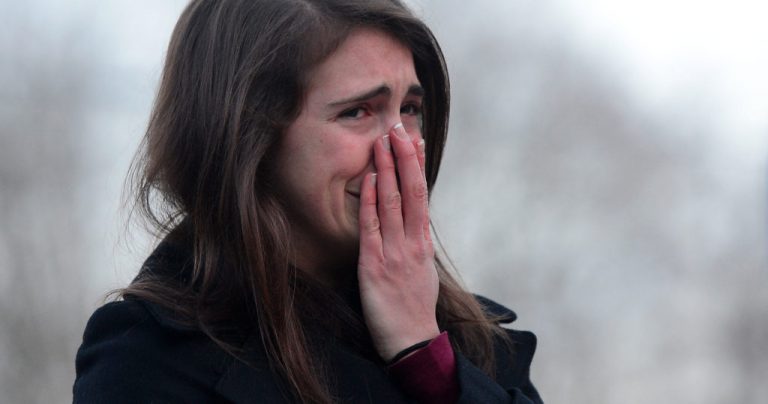
Emmanuel Dunand, an AFP photographer, shot a woman in Newtown, Connecticut, on December 15, 2012. The reportage caption links her tears to remembrance of the victims of the attack on the Sandy Hook elementary school that had happened the day before. The woman's name and her personal connection to the dead are not established by this caption. The photograph conveys real grief, not a scene of a joyful marriage proposal.
Later the image began to appear outside the original news story, and the wave of memes described with it is dated to 2016. Versions with top and bottom lines alternated with collages where a new reason for tears was placed alongside. The date the picture was created and the time it became a reaction template are separated by several years; one familiar portrait went through different ways of being read.
What remained in the frame
The woman has long dark hair, a dark coat, and burgundy fabric at her wrist. She presses her hand to her face, covering her mouth and part of her nose. Her brows are drawn together, her cheeks look flushed, and her gaze is turned slightly aside. The light blurred background does not allow a close look at the people around or the place, so attention focuses entirely on the face and gesture.
The hand both hides the expression of the mouth and strengthens the impression that the emotions are hard to hold back. In a single picture the viewer has almost nothing to hold onto apart from this reaction. There is no visible bouquet, no ring box, or other object that would itself explain the tears. It is precisely the absence of details that let new captions take the plot so far from the reportage situation.
How a caption changes the sign of an emotion
A meme often describes the tears as joy: the gift turned out incredibly sweet, a person did something caring, a long-awaited event finally happened. The photograph keeps the expression of pain. The viewer rereads it according to the assigned occasion, and the sharp mismatch becomes part of the joke. The same hand at the face can signify gratitude, tenderness, bewilderment, or vexation.
The device is especially noticeable next to a trivial cause. The dramatic expression gets a tiny everyday piece of luck: a lost eraser was found, or someone left the last slice of pie. The scale of the feeling becomes exaggerated but recognizable. Such a caption tells about the experience of the meme's author and does not report a new fact about the woman in the photograph.
The collage works a little differently. First the viewer sees an object, then the reaction to it; the connection has to be built mentally. This allows a direct message of happiness to be replaced with a visual comparison. The original news context is usually not present inside the joke, although it explains the appearance of the snapshot itself. The history of the photograph and the invented meme scene remain two different stories.
Three invented causes of meme tears
The first example is a photo of neatly labeled containers in a fridge beside the woman's reaction. Caption: “They left dinner and even explained which lid to close.” Small domestic care is presented as a stunning gesture. The scene is deliberately fictional and refers to the feeling of an author who was suddenly given an easier evening.
In a second variant, a person opens an old folder and finds a backup of a lost term paper. Next to it appears this reaction with the caption “Past me still loved me after all.” The tears express relief at a former decision of one's own. The imagined gratitude to oneself gives a technical discovery the emotional scale of a family gift.
The third plot is built on disappointment: in a box of cookies one whole cookie remains, but it turns out to be two halves lying side by side. The caption “Already started to believe” first promises a little happiness, then takes it away. The photograph completes the invented twist while keeping a familiar drama that in no way describes the woman's real reason for tears.