The frame by the tracks: a flat cap, a cigarette, and an apple
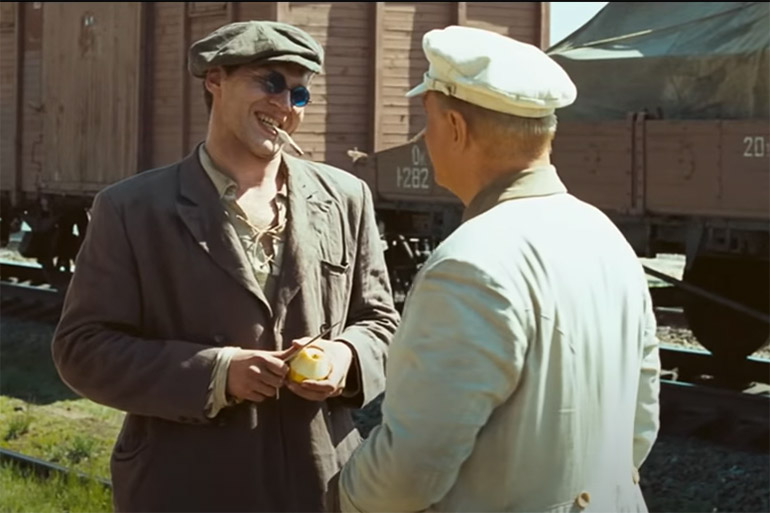
A sunny day, railway tracks, and wooden freight cars, with numbers visible on one of them. On the left stands a man in an oversized gray-brown jacket, a flat cap, and dark round glasses. He has a hand-rolled cigarette between his teeth, is smiling broadly, and is holding a round fruit that looks like an apple; a thin cord is slung across his chest. On the right, with his back to the camera, is a man in a light jacket and a white cap.
The film is sometimes called simply Burnt by the Sun: Citadel. Its full title is Burnt by the Sun 2: Citadel, and the "2" matters here: it's the second part of a two-film story, not the original film.
The train station scene in Burnt by the Sun 2: Citadel
The film came out in 2011, directed by Nikita Mikhalkov, who also played Sergei Kotov. At the station, robbers accost the character and demand his watch. The conversation turns into a fight, in which Kotov uses a metal claw in place of the finger he lost.
The scene is framed by a toy duck: at first Kotov tries to pick it up off the ground but is stopped, and after the fight he finally picks it up and gives it to the girl Vasilisa. The film received low ratings — around 3.6 on Kinopoisk and 4.1 on IMDb — and its box office take was far below its budget. The clip appeared on a video hosting site back in November 2018 and racked up more than ten million views over seven years, so people were already joking about it long before the trend.
Why a watch gets called a "kettle"
"Kotly" ("kettles") is slang for watches. The most well-known version of the story: in labor camps, the start of a break or a meal was announced by banging on metal kettles, and the word carried over to watches. Another version traces it to London slang, where "kettle" meant a pocket watch, and thieves who stole them were called "kettle bangers." A third version is about appearance: old pocket watches, with their lids and loops, resembled little kettles.
The dialogue also has other unfamiliar words: "mena" means a trade, "pa!" is a request for a drag of a cigarette, "poshlo" means agreeing to a deal, and "ne v mast'" means "not fitting your rank."
A dialogue that gets quoted differently each time
Posts don't reproduce the conversation the same way: in some it's shorter, in others lines like "No way!" and "I swear!" get added in. The first line varies too — "Hey mister, tell me the time" versus "Hey mister, tell me the time, huh?" The exact wording is worth checking against the film itself.
This meme is often captioned with the dialogue's second line, "Hey mister, tell me the time," though captions more often quote a different line — "Those kettles aren't for you, pal."
The trio in the bank, "Pa-a!", and other universes
The trend took off in late summer 2025, with a notable push from the channel "Trio v banke" ("Trio in a jar"), which makes parodies of movie scenes. From there, people started reenacting the scene on TikTok and in short videos: they hunted down similar flat caps and vests, hung big watches around their necks, glued on mustaches, and swapped the cigarette for a rolled-up piece of paper or a straw.
The exclamation "Pa-a!" became especially popular on its own. The characters got transplanted into other universes — Harry Potter, Star Wars, Dune, LEGO — and the bespectacled antagonist got compared to Grigory Leps. Actor Alexander Anoprikov, who played the thief, responded to the trend with behind-the-scenes shots from filming.
Lines from the dialogue as captions
"Hey, those sneakers aren't for you, pal, hand them over" — the recognizable construction carries over to any object, and the whole joke is that the complaint is delivered with absolute confidence.
"I'll give you a report, you give me time off. Deal?" — what matters here is the trade itself: the caption is built around the word "mena" and works even for people who haven't seen the film.
"Well, I'm a general" — a short answer to any complaint that works as a ready-made excuse.