What's in the picture
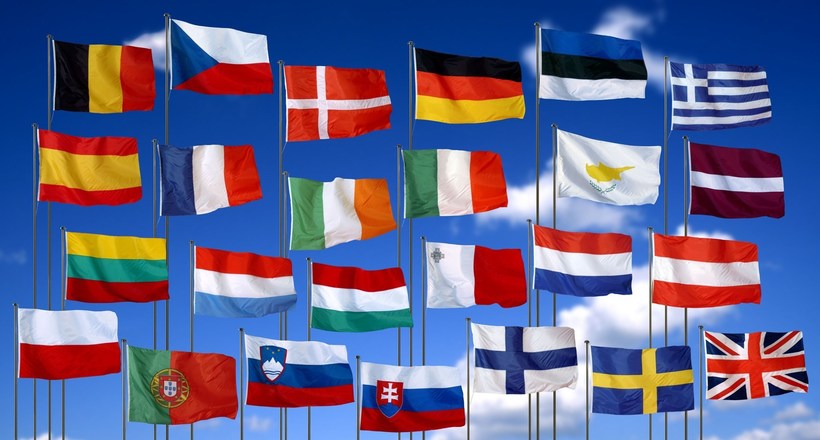
This isn't a photo with a central figure but a stock image: around two dozen flags on tall flagpoles against a bright blue sky with clouds. Recognizable among them are the Belgian, Czech, Danish, German, Estonian, Greek, Spanish, French, Italian, Irish, Cypriot, Latvian, Lithuanian, Hungarian, Maltese, Dutch, Austrian, Polish, Portuguese, Slovenian, Slovak, Finnish, Swedish, and British flags. There's no meme as such here: the image merely hints at the theme of "different countries."
The joke itself lives in the text. The picture is there so the caption can be placed over it or alongside it.
The formula and its origin
The frame of the phrase goes: "In [such-and-such country], people don't say 'X,' they say 'Y' and consider it beautiful." Here "X" is a familiar word or turn of phrase, and "Y" is an expression that turns out to be long, odd, or unexpectedly poetic. Where the format originated couldn't be reliably established: no first author or exact date can be named, and similar constructions along the lines of "they call it something else over there" have been around for a long time.
The main requirement for the caption is that it should sound like admiration for a foreign language or custom, even though it's almost always ironic.
Why it works
The joke has a double meaning: the author pretends to be sincerely admiring another culture and its customs, while actually poking fun at how little we really know about it. The formula also provides a ready-made frame: the reader immediately understands that a "local" expression is coming next and anticipates the promised surprise.
It also plays on stereotypes: if the bit is built on the premise that in some country "people don't talk about being tired, they talk about the rain," the joke runs on that country's well-known image rather than on real facts about it, so it's better to pick gentle, kind observations rather than offensive labels.
Example captions
"In Iceland, people don't say 'I'll come after lunch,' they say 'before the next storm' and consider it beautiful." The joke runs on a climate stereotype: time measured in weather.
"In Finland, people don't say 'I need company,' they say 'let's be quiet together' and consider it lovely." It plays on the image of the silent Finn: the conversational phrase is replaced by its opposite.
"In Germany, people don't say 'this could have been done faster,' they say 'form number three, in duplicate' and consider it beautiful." Funny because of the bureaucratic exaggeration.
"In our office, people don't say 'I'm tired,' they say 'let's circle back to this on Friday' and consider that beautiful too." The format easily turns into an everyday joke without any country at all.
How to use it
The best captions are the ones where the second phrase is shorter and more specific than the first, with its absurdity being what makes it "beautiful." Try not to pass off made-up words as real foreign ones: if the joke is presented as a fact about a language, it's worth checking, or readers who know the language will quickly spot the fake.
The flags in the picture don't have to match the caption. If you need precision, use a different image; if the general atmosphere is enough, this frame works for any version of the format.