What is in the photo
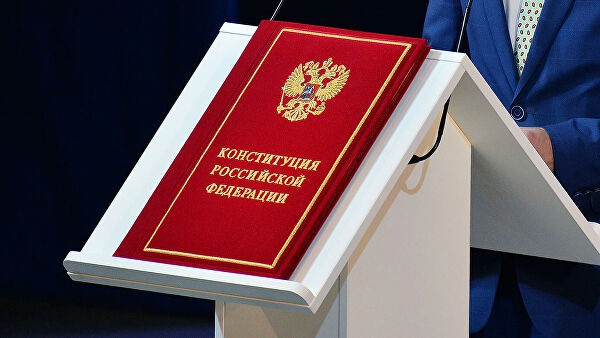
The shot is neutral: a red book with a gold coat of arms and the inscription “The Constitution of the Russian Federation” lies on a light sloped podium. On the right, a fragment of a person in a blue jacket and a tie with a small pattern is visible; the face is not in the frame. The background is dark blue, like the stage of an assembly hall. There are no captions or jokes in the picture itself: what makes it funny are the texts attached to it.
The photo is neutral and suits any conversation about rules or “making amendments”: the red cover with a gold coat of arms, the podium, and a strict suit with no face create the image of an official speech, not of a specific event.
It is precisely this faceless, businesslike look that makes the caption unexpected: the frame resembles a news illustration from a session or a vote, and any everyday phrase placed beside it sounds as if it were spoken straight from the podium.
Chronology of the 2020 amendments
On January 15, 2020, in his address to the Federal Assembly, the president proposed amending the Constitution. On March 2, an expanded package of proposals was submitted to the State Duma: a mention of belief in God, the definition of marriage as a union of a man and a woman, legal succession from the USSR, and a ban on alienating territory. Among the provisions under discussion was also the definition of the Russian people as a state-forming people. Later, on March 10, an amendment about zeroing out the count of presidential terms appeared in the text.
The all-Russian vote was initially scheduled for April 22, but it was postponed because of the pandemic. It took place from June 25 to July 1, 2020.
Where the jokes came from
The reaction on the Russian-language internet was quick and separate from the political debates. People retold the points in a comedic key: in publications about memes of that period, there were mentions of, for example, funny proposals to write the “correct” pizza without pineapple into the main law, and the question “which god did they mean?” was addressed to the press service.
The word “state-forming” raised questions: it sounded as if the label “Russians” were going to be replaced everywhere with this cumbersome turn of phrase. The clumsiness of the wording, terms unusual for ordinary speech, and the dry legal tone that accompanied them became the basis of most jokes.
Jokes about the amendments quickly spread beyond the topic. Captions of the form “amend the rule” began to be applied to family rules, work schedules, and arguments about how to correctly name a dish. The word “amendment” turned into a convenient frame: it is enough to name an absurd clause and add “adopted.”
Examples for your own caption
“I propose that the Constitution be amended to state that Friday after lunch is a day off.” The caption uses the tone of an official initiative and substitutes a personal wish.
“An amendment to the rules of our apartment: the dishes are washed by whoever last said ‘I'll do it myself.’” A household “law” in a solemn format.
“State-forming sofa.” A play on words: the cumbersome term is applied to furniture, and the absurdity is obvious.
“Amendment adopted: tea without sugar is considered a natural disaster.” It works through exaggeration and a dry bureaucratic verb.
How to approach this material
The topic is political, so it is better to stick to form rather than evaluation: a joke about “making amendments” works at the level of language and everyday logic. Captions that attribute to real people words or intentions they never expressed are inappropriate and do not correspond to reality.
The picture can be used whenever you want to show a “serious document” and attach light text to it: office kitchen rules, a club charter, agreements within a family. It is precisely the contrast between a solemn cover and everyday nonsense that works.