What the picture shows
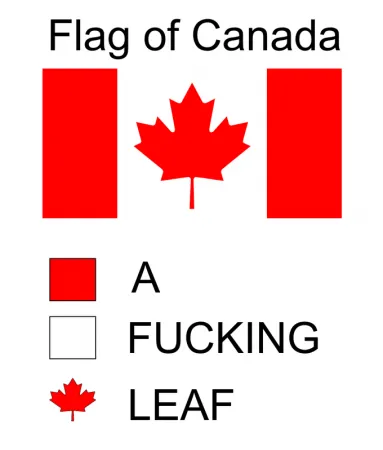
The image shows only the Canadian flag: broad red stripes along the edges, a white field in the center and a red maple leaf with sharp points and a short stem at the bottom. There are no people, text or background, so the picture looks like a pure symbol.
This neutrality matters. The flag serves as a sign of the country, and all the irony is carried by the caption. The same frame can work both as a joke and as an ordinary illustration, so the meaning is set by the text beside it.
What is known about the expression’s history
The retellings mention a person who moved to Canada and described it as a place where everything is flawless: polite people, no crime, very fast internet. But the author, the date and the venue are not confirmed, and even the year sometimes cited cannot be considered reliable.
For that reason it is safer to speak not of a specific person but of a type of account: “we moved, and here everything is perfect.” Such enthusiastic statements are familiar to many from social media, and they best explain why the phrase took hold as a joke.
What the formula means
The construction “Everything is perfect in X” turns personal experience into a general rule. The joke is aimed not at the country as such, nor at the author of the enthusiasm, but at the device of exaggeration itself: everyone is polite, there is no crime, the internet is instant. Each of these claims is easily refuted by everyday trifles, which is why the phrase became a source of irony.
The formula transfers easily to other countries and cities: it is enough to keep the structure “everything is perfect” and insert a similar exaggeration. That is why such captions often look like a separate genre, although they share a common root: generalization from a single experience.
The image of Canada here is conventional. It relies on the common notion of politeness and calm, but the joke does not require checking whether this is true in reality. It works as a gentle parody of any overly enthusiastic review.
Caption examples and why they work
“Moved to Canada: the show loads before I have time to press the button.” Here the loading speed becomes almost magical, and the reader immediately understands that the talk is about enthusiasm, not measurement.
“Even the rain apologizes for getting in the way here.” Personifying the weather takes the idea of politeness to absurdity and shows how far the enthusiastic account has drifted.
“Even the parking ticket here looks like a postcard: a polite note and a wish for a nice day.” The claim sounds confident, but the contrast with common sense itself gives away the exaggeration.
All three captions rest on one device: generalization from a single lucky experience. The more specific the detail, the more visible the gap between the account and reality, so captions are best built on everyday trifles.
How to use the picture
The flag works well as a contrast to enthusiastic text. It suits captions about someone else’s perfect life, advertisements for relocation, or a holiday that looks flawless on social media.
It is important to separate the joke from talk about real people. The meme mocks exaggeration, not a specific person or a people as a whole, so the caption should stay focused on the effect of the account itself. Do not insert anyone’s names or personal stories into the formula.