The gist of the meme
The gist of the meme is that participants take a real national flag, add a color to it that doesn't exist, or invent a new meaning for a color that already does, and write an explanation in the style of an official statement. A typical answer looks something like this: white represents the snow that covers the country's mountains, and blue represents the dream of the sea. The more solemn the wording and the more plausible the combination sounds, the funnier the result.
The game rests on a real tradition. Many states genuinely give official interpretations of their colors: green is linked to nature or Islam, red to blood shed for independence, yellow to the sun or to wealth. Such explanations often appear only after a flag has already been adopted, and they sound like ready-made formulas. The parody works precisely because it mimics this style while swapping out the content.
Origin
The exact date of the first post and the original thread have not been fully established. The meme dates to 2017 and is tied to Reddit, where challenges like this tend to grow quickly through comments: one participant invents a color, another builds on it, and after a few replies a whole "flag backstory" emerges. The specific earliest posts are not known.
The Canadian flag parody
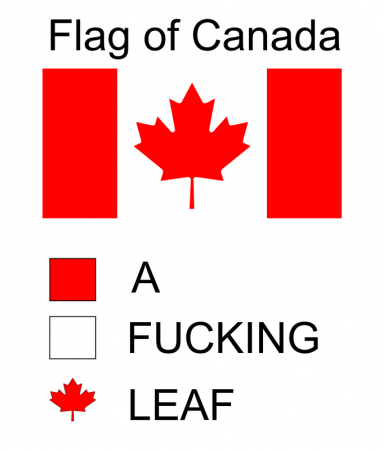
A separate strand of the meme is a parody "Canadian flag." Under an image of the flag, with its recognizable maple leaf centered, runs a legend made up of three labels: a red square with the letter "A," a white square with the word "FUCKING," and a red maple leaf labeled "LEAF." The result is a parody of instructional flag-legend diagrams: the form is official, the content deliberately crude.
Why it works
The meme works well in comments under news about national symbols and in discussions of flags in general. It doesn't mock any particular country and doesn't seriously target its symbols: the object of the joke is the very habit of finding deep meaning in colors. That's why the challenge is usually taken as a harmless game. The format is also handy for conversations about media literacy, since it vividly shows how easy it is to invent a convincing explanation out of thin air.
The takeaway: the meme is an example of how the internet turns official-sounding language into material for play. The most successful answers lean on a recognizable style while swapping out the content, which is why the same tricks keep reappearing in new variations.
There's also a practical upside to games like this: they show how easy it is to create a plausible-sounding explanation if it's written in a familiar style. Users have noticed that the more technical detail a caption contains, the more convincing the fabrication looks, and many of the best answers are built on exactly that. So even a short challenge can become an occasion to talk about how to check sources and tell official information apart from a joke. For people who love heraldry, jokes like this are also a chance to recall the real rules: the colors on flags are usually chosen so they can be distinguished and reproduced easily.