What is in the picture
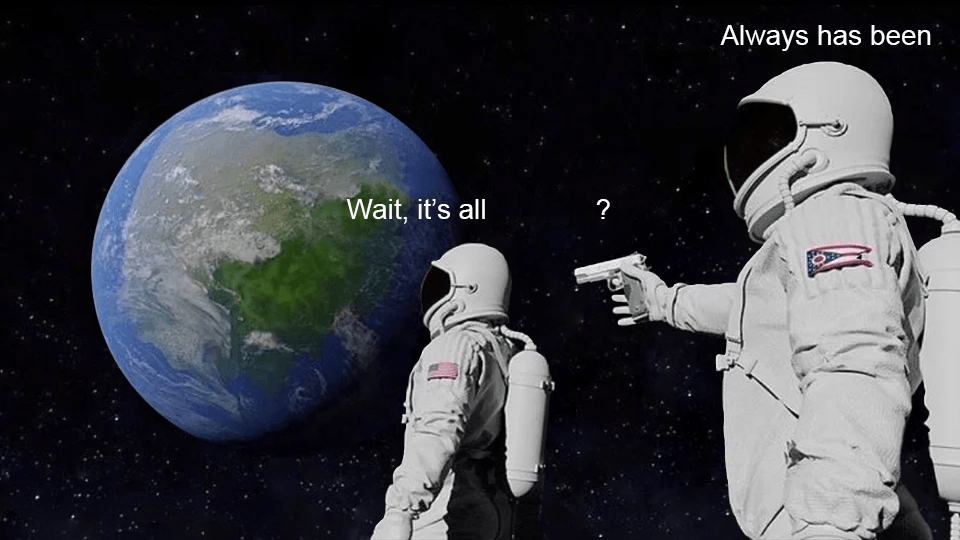
On the left in the foreground is an astronaut in a spacesuit with a US flag on his sleeve. He is turned toward Earth and gazes at it. On the right, closer to the viewer, is a second astronaut, on whose sleeve an Ohio flag is visible. He holds a gun pointed at the back of the first. Around them is black space with stars, and in the middle a large blue planet.
In the version from the collection the text is left as a template: on the left “Wait, it’s all …?” with an empty space, on the right “Always has been.” The ellipsis stands where the subject of the joke should go. The Ohio flag is no accident: the most famous variant of the joke is tied to this state.
From a paint drawing to a realistic frame
The meme went through several stages. According to reports, the earliest version appeared on Reddit in December 2016 as a Paint drawing about a flat Earth: “Wait, it’s flat?” — “Always has been.” In August 2018, an anonymous 4chan user posted a template considered the earliest recognizable one: there, America stood in place of Earth.
The Ohio variant came later: an iFunny user under the nickname iOhioan made a version where the astronaut discovers that the entire world is Ohio. This is the version that became most famous. The realistic version with rendered spacesuits and Earth, as it is known today, was posted to r/memes in June 2020 by a user with the nickname nickslicktricks. The template has no single author.
How the formula works
The structure is always the same: the first astronaut voices a discovery, and the second confirms it with the phrase “Always has been.” The gun adds an unexpected twist: confirming the truth means silencing the one who speaks it.
In Russian-language variants the lines are usually translated: “Wait, is this all …?” — “It always was.” Any word can go in the empty slot: an everyday fact, a profession, a scientific discovery. The more unexpected and mundane the discovery, the stronger the contrast with the threatening answer.
Why the template lives on
The formula is structured as a mini story: discovery, pause, answer. It is easy to remember by substituting your own words, and you don’t need to know the origin of the picture at all.
Moreover, the template allows two intonations: naive and grim. When an everyday trifle is put in the slot, the result is a light joke. When a major topic is inserted, a shade of conspiracy theory appears. It is this flexibility that made the frame one of the most recognizable templates of the early 2020s.
Caption examples
“Wait, is it all the same algorithm?” — “It always was.” A joke about a recommendation feed in which everything looks too similar.
“Wait, is it all pasta with sausage?” — “It always was.” A caption about the student canteen menu, where the choice is an illusion.
“Wait, is my weekend just cleaning?” — “It always was.” Light self-irony about adult life.
“Wait, it’s all Ohio?” — “Always has been.” The classic variant that people still refer to.
Usage tips
Choose discoveries that viewers perceive as “obvious in hindsight.” Then the second astronaut’s answer sounds natural. Try not to use the meme for jokes about real violence against people: a weapon in the frame only deepens the grimness of the caption.
And finally, do not overcomplicate. Two short lines and one unexpected substitution object are enough. The picture has already done the rest.