What the picture shows
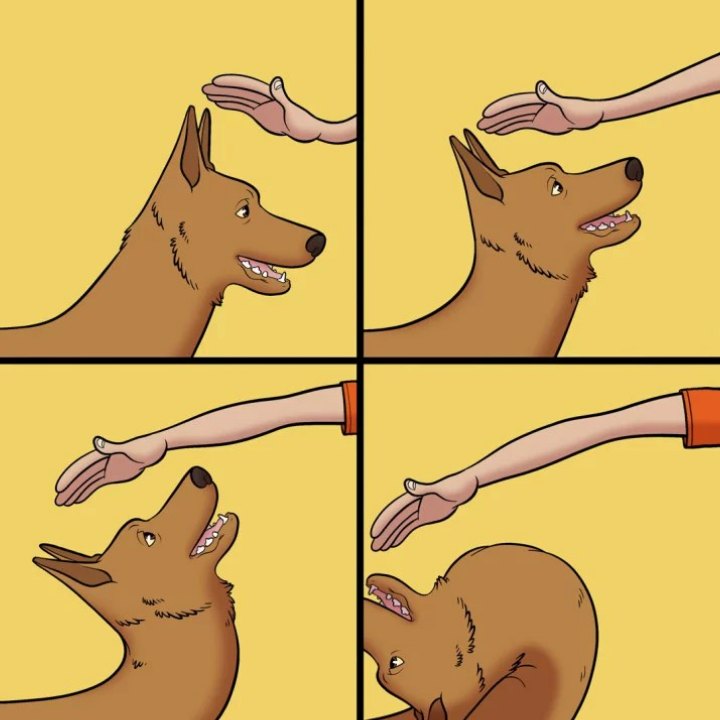
The meme consists of four square panels separated by black lines. All the frames share the same saturated yellow background, and the character is the same in each: a reddish-brown dog with pointed ears and a light muzzle. In the top-left panel, a hand enters from the upper right and reaches toward the animal's head. The dog eyes it warily and opens its jaws slightly, baring its teeth. In the top-right panel, the dog raises its muzzle, the hand still hangs above it, and its mouth is still open. In the bottom-left panel, the animal tilts its head almost vertically, and the hand now rests on its muzzle. In the final panel, the dog arches its neck back so far that its head ends up beneath its body, while the hand keeps hanging in the air. According to the database description, the neck is bent at roughly 180 degrees. The hand barely changes position across all four frames; only the dog's pose changes.
How the joke works
The structure builds gradually. The first two panels set up expectations: the dog simply does not want to be touched and expresses this through its expression. The third panel turns the tension into physical action, and the fourth delivers an unexpected payoff, because the animal avoids the touch not by pulling back or stepping aside but by literally twisting itself inside out. This final frame gives the whole series its meaning and is the main source of the humor. The hand works as a constant: it always reaches for its target and always fails to connect. Viewers see the repeated action and understand that the dodging keeps getting more elaborate.
Origin and dating
The meme dates to 2017. The exact author, the first place of publication, and the original version are not known, and the date remains unconfirmed. The image is drawn in a simple vector illustration style, the dog's breed is not identified, and the character has no name in the description.
Usage examples
The format transfers easily to any situation where someone tries to avoid something unpleasant while another person keeps pushing them toward it. Captions are usually placed on the first two panels to show growing reluctance, and the final frame is left without text. For example, the first panel might read 'When the boss says, let's just take a quick look at one report on Saturday,' and the last panel has no caption, because the arched neck explains everything on its own. Another version: 'When relatives ask when the wedding is,' with the same final frame. Such captions work because the most uncomfortable situations usually end exactly this way: the person doesn't just refuse, they try to vanish from the frame by any means possible.
Why the format sticks
The meme relies on the animal's recognizable body language, which reads without words. The dog does not speak, gesture, or have much expression beyond its tense jaw and flattened ears, so viewers read its state directly. The yellow background makes the image bright and easy to recognize in a feed, and four panels allow a short story without extra detail. The format is flexible: it can be cropped down to two frames or, conversely, extended with intermediate states of your own. That openness explains why the picture remains understandable years after it appeared.
Tags and catalog search
The catalog entry carries the tags '2017,' 'Animals,' and 'Dogs.' This is enough to find the meme by subject, but not by mood. For searching by meaning, it helps to use queries like 'dodging,' 'unpleasant,' or 'don't want to,' since these words describe the situations in which the picture is used most often. Searching the description text will also help people who remember what the meme shows but not its name. If other versions of this series with different characters appear in the catalog, it makes sense to link them to this card rather than duplicating the description.