What the picture shows
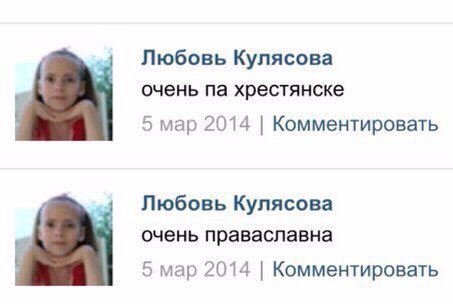
The screenshot shows two consecutive comments from the same user on VKontakte, under the name “Lyubov Kulyasova,” with the same small profile photo (a girl in red clothes against a beach backdrop). The first comment, dated March 5, 2014, reads “ochen pa khrestyanske”; the second, with the same date, reads “ochen pravaslavna.” Both texts are misspelled: the intended words were “po-khristiansky” (“in a Christian way”) and “pravoslavno” (“in an Orthodox way”).
Origin
Both comments are dated March 5, 2014, but the phrases began spreading as a recognizable meme later, around 2016, when they were used as a sarcastic description of “un-Christian” situations. The context of the original argument in which the comments appeared has not been reliably established: the screenshot spread across public pages without any indication of the original discussion topic.
The spelling mistakes (“pa khrestyanske” instead of “po-khristiansky,” “pravaslavna” instead of “pravoslavno”) became the meme’s key recognizable feature and a source of extra comic effect: semi-literate spelling of words about religious morality amplifies the irony.
How the phrase is used
“Very pa khrestyanske” and “very pravaslavna” are used as sarcastic comments on situations that flagrantly contradict professed Christian or Orthodox values: aggression, rudeness, hypocrisy, showy piety alongside unethical conduct. The phrase works like other ironic clichés of the “very laconic” type, but with a specific reference to religious morality.
Typical uses in comments under posts: someone shares a screenshot of a quarrel in a chat full of insults and captions it “ochen pa khrestyanske”; or under a photo of a plainly unethical act someone writes “well, exactly, so pravaslavna.”
Spread across the Russian internet
The meme took hold mainly in the Russian-language internet as a stable linguistic unit, used separately from the original screenshot. The phrase “ochen pa khrestyanske” or “ochen pravaslavna” is typed as plain text in comments without any picture, in the expectation that the audience will recognize the reference. Such detachment of the phrase from its source is a typical sign that the meme has become an enduring internet cliché, like many other screenshots of VKontakte exchanges from the mid-2010s.
Screenshots of VKontakte comments with spelling errors were in general a mass source of memes in the Russian internet in the mid-2010s. Users collected and reposted the odd statements of barely known people, turning individual phrases into folkloric quotes that live on independently of the original commenter.
Why the meme remains recognizable
The phrase’s long life is explained by its concision and versatility: two short word combinations can acidly comment on almost any situation of hypocrisy on moral themes, without being limited to religious subject matter. The spelling errors in the original also act as a “trademark” by which the phrase is recognized even without a cited source.
The format is also notable because, unlike many image-based memes, it has no single “canonical” visual template for reposting. The two-comment screenshot is not always used; more often the phrase itself is retyped as a fresh comment under a completely different post. This sets “ochen pa khrestyanske, ochen pravaslavna” apart from picture memes such as reaction templates: here the text comes first, and the image is mainly a historical source that can be recalled on request, but it isn’t required to use the joke.