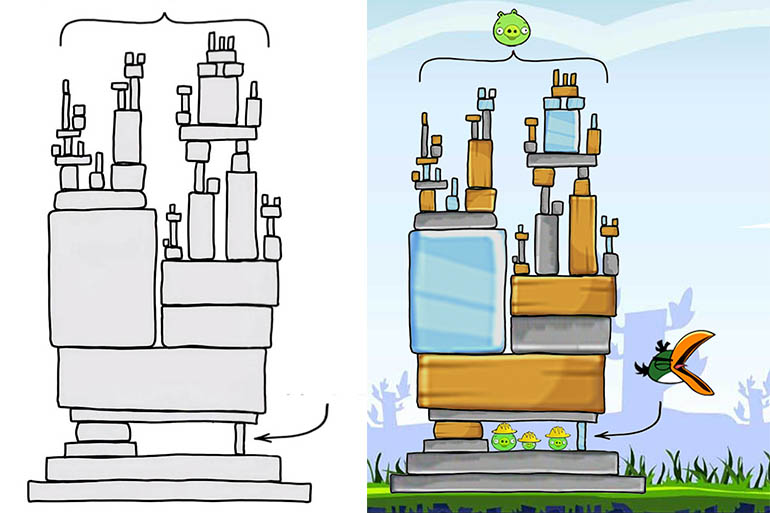
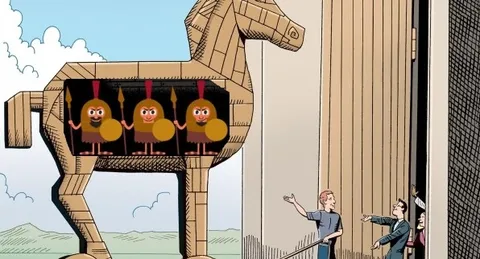
The original drawing
The local image shows a tower-like structure made of many rectangular blocks. At its base there is a thin support that carries the entire load. The diagram recalls the comic "Dependency" by Randall Munroe, published in 2020: in the original, an entire digital infrastructure rests on a single open-source project maintained by one stranger.
Reworked versions change not only the words but also individual details of the diagram. In some the structure is shown as a tower, in others as a chain of applications or a large business process. The original observation concerns the vulnerability of dependencies in software; the meme has extended it to any situation in which a small part supports a much larger whole.
How the joke works
Visually, the top of the diagram looks complex, important and stable. The small support at the bottom seems random and fragile, but without it everything would collapse. The contrast between scale and importance reads instantly: a system may look professionally organized while depending on a single inconspicuous piece.
In the original, this is not just a joke about bad management: the comic points to a real problem of the digital ecosystem, where software projects are reused in a chain of dependencies. User versions keep the general principle but do not necessarily refer to open source. When retelling the source, don't replace it with the claim that every big company literally rests on one person.
Meaning in other contexts
In an office, the thin support might be the coworker who remembers the password to a system. At home, it is the extension cord connecting all the equipment in a room. In school, it is the one set of notes the whole group studies from before an exam. The template shows that outward scale does not always match actual stability.
The joke sometimes expresses gratitude to an invisible specialist, or annoyance at the lack of a safety net. It can be read as a friendly meme about an irreplaceable person, but not as an accusation against that person. When a system depends on one participant, the problem is usually the organization and the lack of redundancy, not that they "let everyone else down."
New captions
"The whole presentation depends on the person who remembers where the final version is saved" is a version for a work chat. "All the home devices are connected through one adapter bought ten years ago" brings the joke into daily life. For a small project: "The release plan, the database, the documentation and one script that only Sasha understands."
You can label each block "team," "service," "client portal," and add "a project with one maintainer" to the support. This version is closer to the digital meaning of the original and can be a reason to discuss backups, documentation and the distribution of responsibility. For a household version, keep the structure simple: the fewer words, the more noticeable the vulnerable support.
In the original comic, the support is a third-party software project that many products rely on; in the local copy the blocks are replaced by a tower. It is useful to preserve this difference: the comic jokes about infrastructure with a real dependency, while the variation applies the same idea to any shaky balance. For example, "the whole family budget rests on a coupon that expires tomorrow."
This turns a hidden dependency into a clear image.