An ancient ruse and a modern cartoon
In the legend of the Trojan War, a wooden horse conceals Greek warriors. The city's inhabitants take it for a gift and let it inside the walls; the present turns out to be a way around the defenses. To understand the meme, this sequence matters more than the historical accuracy of the myth: danger gains access thanks to an attractive appearance and a trusting decision on the receiving side.
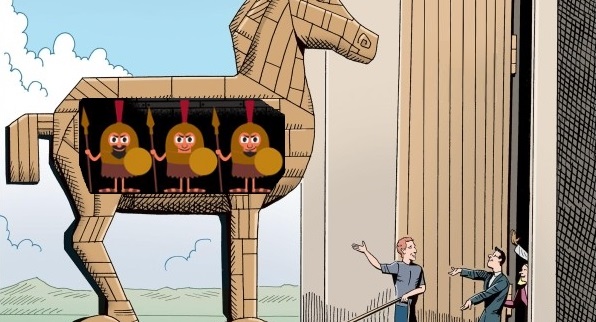
The artist Martin Kozlowski used the story in a cartoon for a piece about Instant Articles, published on May 13, 2015. Facebook offered publishers the chance to post articles directly inside the platform. The drawing juxtaposed the appeal of the offer with the risk of publishers' dependence on an intermediary. The original version featured the Facebook logo and the name The New York Times. This is a specific source of the composition, but not yet a universal macro with everyday captions.
What changed in 2018
In July 2018, the image began circulating as a format with captions attached to objects. Among the early traces are posts on Instagram and Reddit from July 17. The meme version erased the newspaper inscription and replaced the platform's sign inside the horse with three drawn warriors. As a result, the political-media cartoon became a neutral scheme: an offer, hidden contents, and its recipient.
The picture shows precisely this remake. A huge wooden horse stands on the left by tall gates on the right. Its side is open, and inside are three small figures with shields and spears. At the entrance, people discuss the find; one gestures toward the horse for the others. The viewer sees the inside of the gift, although the characters at the gate behave as if they have just come across an ordinary lucky find.
Three roles instead of one reaction
For the caption, the separate roles of the horse and the warriors matter. The horse stands for what a person has agreed to: a free trial, a pleasant meeting, a profitable offer. The warriors stand for the unexpected burden that comes with this agreement. The people at the gate become participants who have not yet realized the catch. If the same thought is written on the horse and on its contents, the main contrast between promise and result disappears.
The joke can do without malicious intent. Sometimes unpleasant consequences are hidden because the hero is overly optimistic about his own abilities. Then the horse is his own plan, and the warriors are the difficulties he preferred to forget. The viewer's position above the situation remains the same: we see in advance what the hero will discover only after making the decision.
Invented gifts with contents
The example "A new notebook for neat notes" on the horse and "Three weeks of rewriting old notes" inside mocks excessive preparation. At the gate you can caption it "Me, who just needs to study." Another scenario: "A short walk with friends" carries "Five stores and an argument about where to eat." A pleasant invitation gradually unfolds as an entire program.
A third variant: the horse is "One more houseplant," the warriors are "A lamp, a repotting, and a search for a free windowsill," and the receiving side is "My little study." Such examples keep the structure of the legendary ruse but transfer it to harmless everyday decisions. The inner captions are best read after the outer ones: that way the meme reproduces the moment the gift is exposed.