The peacemaker from Pandyland
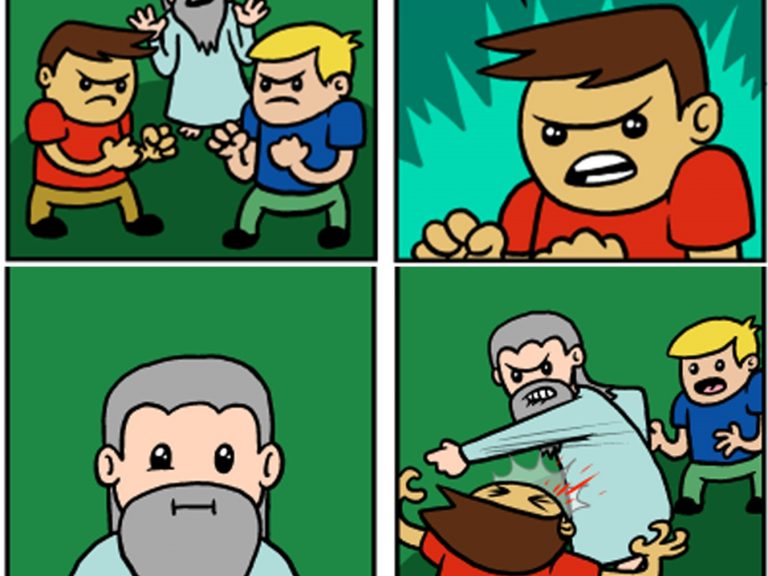
The basis of the format is the comic Andy Pandy, tied to his Pandyland project and circulating in 2015. In the original scene, two young men quarrel, while a bearded character playing a god intervenes with a call to renounce violence. One of the interlocutors turns the lecture into a verbal trap, after which he himself receives a blow. The ending exposes above all the teacher’s patience: the rule turns out to be harder to follow than to pronounce.
The original English pun was built on the word “answer,” which refers to a reply to a question. The interlocutor literally played on the saying that violence is never an answer. The Russian title with “way out” conveys the general meaning but weakens this wordplay. In March 2015 a Spanish square-format reworking appeared, and later new lines and captions spread. In 2018 the comic was again widely used in template discussions on Reddit.
Four panels without explanations
In this version there is no text and no speech bubbles. First we see angry young people in red and blue T-shirts; between them, behind, stands a mediator with raised hands, and the top of the frame cuts off his head. Then come two close-ups: the young debater and an old man with a long beard in a blue robe. The last panel shows a blow to the man in red and the surprise of the second participant.
The alternation of wide shots and faces creates a ready-made conversation even without captions. The first frame sets up the conflict, the second allows a provocative line to be inserted, and the third promises a reasonable answer. Instead of an answer, the fourth frame abruptly returns the action to what the old man was about to stop. This delay makes the blow unexpected, although the irritated face already signals an impending breakdown.
Who breaks their own rule
The usual remake assigns the mediator the role of an administrator, a mentor or a supporter of polite discussion. The young men take on mutually exclusive positions, and one of their remarks becomes the last straw. Sometimes the blow replaces a familiar online action: blocking, deleting a message, muting a microphone. Then the comic shows how a promise to talk calmly gives way to the desire to end the argument at once.
The situation works especially well when the provocation formally matches the declared rule. A participant may ask a permissible question, follow an instruction too zealously, or ask for an obvious thing to be explained. The more confidently the mediator promised patience, the sharper the contrast with the ending. If, however, he is presented from the start as an angry opponent, the joke changes: instead of self-refutation, we get an ordinary victory of one debater over another.
What this looks like in an invented conversation
An invented scene about a board game: the host asks that disputed rules be discussed calmly. A player asks why the host interpreted the same card in opposite ways in two rounds. The blow stands for an irritated announcement that the discussion is closed. The comedy arises from the mismatch between the declared openness and the reaction to being questioned.
Another invented version is family lessons in using a computer. The mentor promises to answer any question, and the student asks why the shutdown button opens a menu. The final panel depicts the mentor’s wish to press it himself and end the lesson.
In a third invented example, a chat organizer demands that people not argue about favorite kinds of pizza. Someone asks whether a ban on discussing pizza counts as discussing pizza. The peacemaker loses not the taste argument but the test of his own ban.