A food argument becomes a battle scene
The comic by artist Dodge Greenley spread in May 2018. In the original joke, the participants embodied food preferences: hot dogs and hamburgers fought for supremacy, and the appearance of tacos unexpectedly ended their contest. The author gave an ordinary conversation about tastes the form of a fantastic fight. The seriousness of the poses and weapons was deliberately out of proportion to the subject of the dispute.
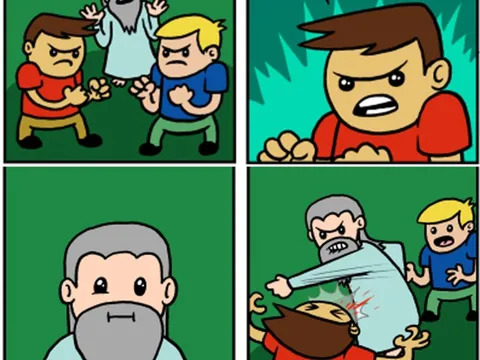
The full story had three stages: a first attack, a response, and the intervention of a new opponent who defeats both. Remakes began to replace the food roles with films, hobbies, and other rivals. Already in early discussions on Reddit, the format was used for competing projects from the Star Wars universe. In such use the decisive force is the caption author's favorite option, and the original discussion merely prepares its striking arrival. At the same time, the common templates might not keep all the panels of the original work.
What is left in two panels
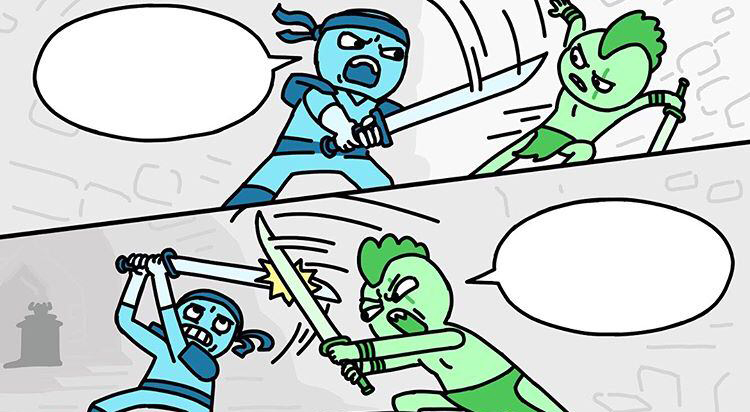
In the top panel, a blue character with a headband and a sword lunges at a green opponent. Below, the situation changes: the green one responds, and the blue one's face shows fear. The action unfolds against a gray brick wall. The white speech bubbles are empty. There is no third creature and no final resolution in this picture.
The two panels already form a small story of shifting confidence. At first it seems the blue fighter fully controls the initiative; then his advantage disappears. The empty bubbles make expressive poses more important than specific vocabulary. The text may stand for the arguers' points or the things being compared, but the movement stays the same: one loud claim receives an equally decisive answer. A viewer who knows the full comic may expect the next surprise, but this crop itself ends before it.
Confidence that lasts one line
Battle language turns an argument into a visible clash. Here the point is not simply spoken: it is advanced upon, parried, and used to frighten the opponent. Such literalness is funny when the captions concern quite peaceful questions. The choice of a side dish or a note-taking app gets the energy of a duel, as if the loser stood to lose far more than the right to voice an opinion.
The full version has an additional mechanism: a sudden change of the entire scale of comparison. A third participant does not accept the rules of the first two but shows how limited their argument was. The two-panel version focuses more on the counterargument and the loss of self-assurance. These structures are related but work with different endings. Therefore the empty bubbles can serve both a short exchange of jabs and the setup of a longer story: the tone is determined by the point at which the fight is stopped.
Lines for peaceful duels
In an invented dialogue, the blue fighter insists: “My notes never get lost, I write everything on paper.” The green one replies: “Then where's the notebook?” The second panel turns a technical advantage into its own weakness. Another example concerns food: the first participant boasts about cooking dinner in ten minutes, and the second asks whether he counted the hour of scrubbing the pan. The attack and the response reflect a collision between a beautiful formula and an omitted detail.
For the full three-part version one can invent an argument about who commutes better: the car driver or the subway passenger. Both list the merits of their route, and the third force is a colleague who works from the next room at home. His appearance changes the question from the convenience of transport to whether the trip is needed at all. Thus the different variants keep one artistic habit: depicting an ordinary comparison as a battle so important that each new argument literally shifts the balance of power.