Deathbulge's first lesson
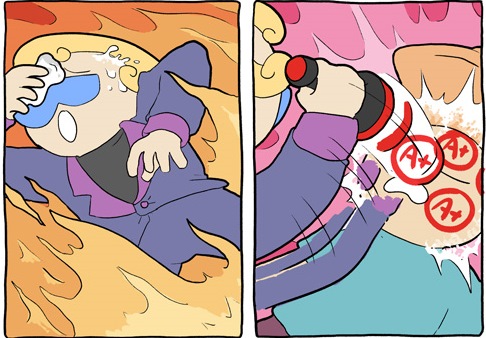
Artist Dan Martin published First Class in his webcomic Deathbulge on February 27, 2017. In the full story the teacher announces flirting as a new school subject and asks the pupil, Jose, to come up with a line for an introduction. The answer is built on a crude Christmas pun about Santa and a chimney. The teacher gets excited and begins stamping red A+ grades directly onto the boy's face. The absurd reward completes the satire on teaching ready-made “perfect” pickup lines.
The comic was quickly remade. Already in March 2017 Reddit had versions with the answer replaced: from a short exclamation to lines from Star Wars and gaming references. By 2018 the format kept spreading and received a recognizable Russian name. The original school subject stopped being mandatory: from the same sequence one can make a lesson on memes, professional jargon, or any topic where the audience recognizes its own passwords.
The last two panels
This image contains only the comic's ending. On the left the teacher leans back in delight, holding a white handkerchief to his forehead; a blue stripe is visible on his face, and orange flames are drawn around his body. On the right, a hand with a stamp and the pupil's face covered in red A+ grades are shown in close-up. The initial announcement, the question, and the pupil's line itself are absent here. So the image can work as a brief approval: the cause of the enthusiastic reaction comes from the caption or the preceding message.
A grade you cannot ignore
The joke flips the usual school procedure. The grade is not entered in a register or written on a sheet, but placed on the face; one top grade is not enough, and the teacher repeats it again and again. This physical exaggeration makes the approval almost a character in its own right. The teacher doesn't simply agree with the answer: his reaction is so big that it breaks all the usual rules of grading and communication.
In the full layout, the funny line appears between a calm question and an excited award. Sometimes it is genuinely witty, sometimes obviously a flop. In the second case the comic mocks the tastes of the teacher himself or of a group for whom banality counts as skill. The fragment with the last two panels allows skipping the question and answer entirely. Then the viewer only needs to recognize the line that provoked admiration, and the drawing performs an overly solemn “exactly what we were waiting for.”
Answers for an imaginary exam
In a fictional example, an adult visitor to a board game club meets another adult and asks: “We have a common taste: do you also read the rules before the game starts?” The teacher responds with blazing delight. For this group, the appeal lies in the rare combination of liking someone and being willing to spend an evening on instructions, so the A+ reads as a reward for knowing the local habits.
The second fictional scene is set in a technical support course. Asked about the first action, the employee replies: “I'll check whether it's the same computer we're talking about.” The teacher covers his face with top grades. The down-to-earth check looks worthy of a medal, because the imagined group remembers too well the conversations in which half an hour was spent fixing an entirely different device.
The third fictional variant is a get-to-know-you lesson for plant lovers. The adult character suggests the companion choose a pot with drainage holes together. Instead of the expected romantic banality, we hear concern for future seedlings. The mentor's delight turns a narrow overlap of interests into the highest art of flirting, though to an outsider such a line looks extremely ordinary.
Approval without conversation
If only the two final panels are kept, the format approaches a reaction to someone else's comment. The author does not retell the whole lesson but instantly awards a grade for a well-phrased line. Context determines whether he praises the line seriously or laughs at the reward system itself. The repeated red A+ grades keep it recognizable even when the story of the introduction gives way to a completely different topic.