From an exam joke to a standalone reaction
In March 2018, the artist Foccoon published a comic about an approaching exam session and studying for exams. A situation familiar to students was turned into a very literal model: the problem does not disappear once it has been thrown away, but goes full circle and comes back. The drawing spread on VKontakte and Pikabu.
In early June 2018, a version of the comic appeared on MDK with a different caption, and the storyline got a new wave of remakes. Authors replaced the study theme with household chores, other people's demands, and their own promises. The date of the original publication explains where the drawing came from, but does not establish the first person who came up with each new caption. The persistent sequence of actions proved more important than the original name of the problem: the throw can be renamed, but the return stays the same.
Why the final panel is recognized on its own
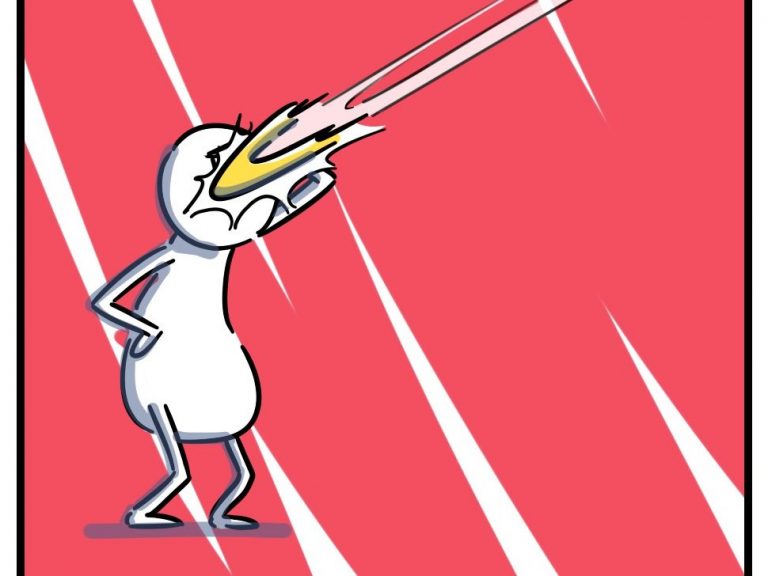
Only the final blow is shown here, not the whole comic. A white stick figure stands on the left; a yellow boomerang smashes into his head, deforming his face. The red background and white lines heighten the sense of sudden motion. The picture contains no original caption about exam preparation, and there is no visible moment when the object was thrown. The backstory has to be reconstructed from the shape of the boomerang or supplied in words.
The character has no detailed clothing, recognizable profession, or surrounding interior. So the panel transfers easily to different situations without requiring a new event to match the scenery. The face is crushed so clearly that the reaction stays readable even at small size. The red flash turns the moment of realization into a physical blow: the hero did not simply remember the problem, he got it back at full speed.
Return as the structure of the joke
The boomerang gives the meme a causal chain: a person sent something away, time passed, and it came back. The final panel works best when the caption lets you see both ends of this chain. A plain “I feel bad” uses only the facial expression. The phrasing “Me after my own ‘let’s discuss this on Monday’” adds a recognizable cause, a pause, and a reckoning, even though the previous panels are not shown.
At the same time, the returning object does not necessarily stand for punishment or justice. It can be a letter, a badly worded message, an old joke, or a question that really did need time. The comic effect arises from the mistaken feeling that distance or delay cancels the existence of a thing. The boomerang keeps its connection to the person who threw it, so a random external misfortune fits worse than an event with a clear backstory. The meme shows a closed loop, not just a blow from nowhere.
What might come back in invented examples
The first variant: a chat participant writes, “Let’s pick a name next week.” A week later, the discussion opens with his own message, highlighted in color. The caption for the hit reads “Next week has arrived.” There is no separate villain here: the boomerang is the hero's own agreement, which he temporarily stopped noticing. The interval between the two events is the hidden center of the comic.
The second example: a person came up with a ridiculous nickname for a game character, and his friends started calling him that. The throw turned into an unexpected assignment. The third: a quiz host promises to add “one easy question from me,” but at the end he is asked to answer it himself. These situations differ from the original textbook scenario while keeping the movement of the joke: the hero first controls the topic of conversation, then discovers that it has been turned back on him and no longer obeys his earlier plan.