Where the frame comes from
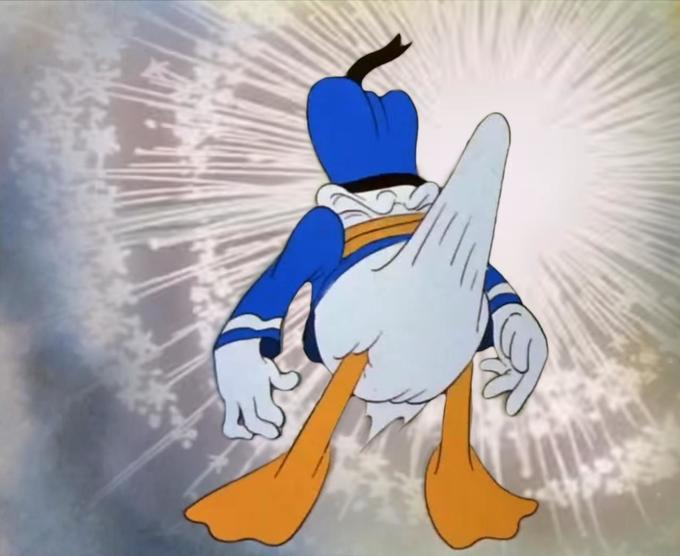
The image comes from one of the short cartoons about Donald Duck produced by Walt Disney Studios, released from the 1930s to the 1960s. In the frame, the character is shown from behind, hunched, with his tail feathers raised. Because of the angle and the backlighting, the feathers form a single elongated silhouette between the duck's legs. The background has a bright flash or glow, typical of the animation effects of that era, which further emphasizes the silhouette and makes it more noticeable to the viewer.
The frame itself is an ordinary moment from a cartoon, with no hidden subtext placed there by the artists. The character's pose conveys fright, surprise or a sudden movement, standard for the studio's comedic animation. The ambiguity arose purely from the accidental coincidence of the shape of the tail feathers, the lighting and the angle.
How the frame became a meme
The frame began circulating online as a funny find: a screenshot in which a random still from old animation looks suggestive. Such finds are a popular genre of internet humor. Viewers hunt through old films, ads and cartoons for frames that, because of a frozen motion or an unlucky angle, turn into something other than what the authors intended.
The image spread through themed communities and collections of “cartoons with a hint,” where it was often placed alongside other similar oddities from classic animation: moments where shadows, folds of clothing or characters' movements accidentally form suggestive shapes.
The logic of the joke
The humor is built on the contrast between the good-natured, child-oriented image of Donald Duck and the unexpectedly crude reading of this specific frame. The effect is amplified by the fact that the character is one of the most recognizable symbols of Disney family animation, so a suggestive still featuring him reads as especially absurd and funny.
The frame is usually posted with no caption or only a minimal one, since the silhouette speaks for itself. Viewers need to see the picture once to get the joke.
Typical captions
The frame is most often accompanied by short ironic remarks along the lines of “what did the Disney artist mix up” or “a camera angle no censor would let through today.” The image is also used as a reaction to the topic of “chance or design oversight,” when conversations turn to odd frames from old films and cartoons.
A separate category of captions plays on generational contrast: “cartoons from our childhood, rewatched as adults” is a format in which viewers share moments from their favorite childhood works that read differently years later.
The meme's place in the culture of odd frames
“Donald Duck's Boner” is one of many examples of so-called “accidental” memes, which arise not from a deliberately staged scene but from a single unlucky still frame. Similar finds regularly surface in connection with classic animation, commercials and even news broadcasts, becoming collectibles for fans of internet oddities.
Despite the absence of any authorial intent, such frames lodge in internet collective memory and periodically resurface in different compilations years after the first post.