What is in the picture
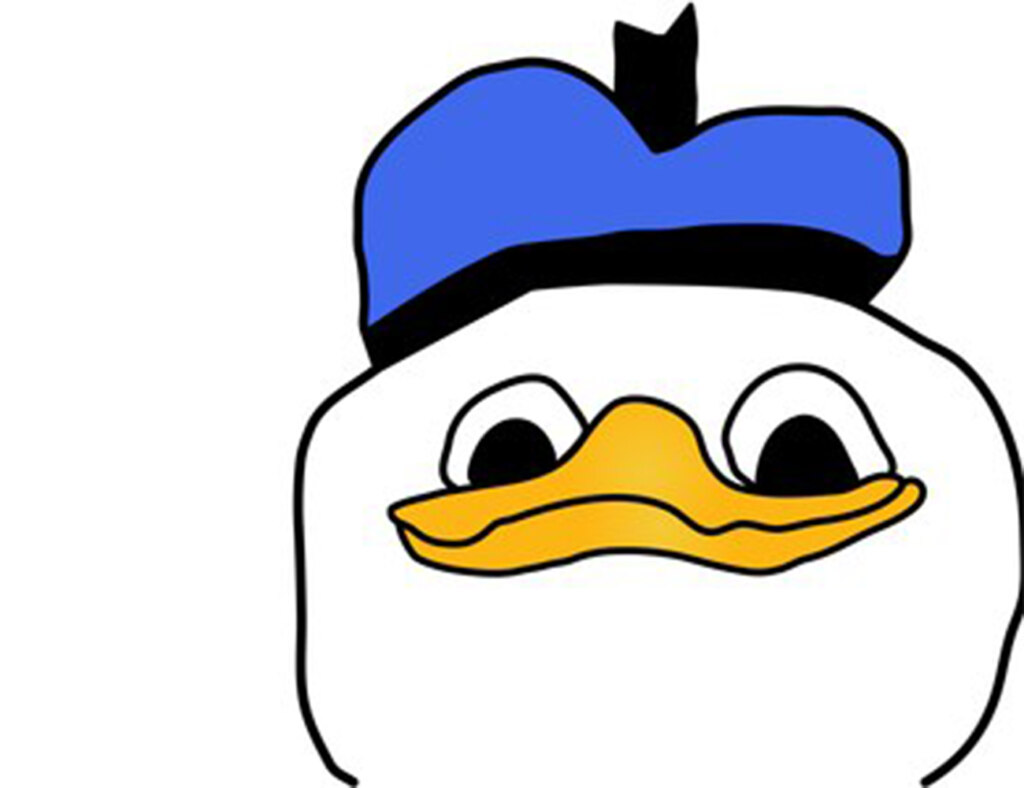
On a white background is the head of a duck, cropped close. On top sits a blue hat with a wide black stripe and a protruding black tuft; beneath it are two round eyes with black pupils, turned downward and slightly to the sides. Between the eyes is a large orange-yellow beak, slightly curved, as if the character is looking at its interlocutor skeptically or anxiously.
The lines of the drawing are uneven and the colors are flat. This deliberate sloppiness is part of the genre: the character looks as if it were drawn in a minute in a simple graphics editor.
Where Dolan came from
According to overviews of internet culture, the character was created by an artist under the pseudonym Sakolut in the summer of 2010 on a Finnish imageboard. The comics were originally called “Aku Ankka,” the Finnish name for Donald Duck, and Dolan is a deliberately distorted version of that name. Among related characters, Gooby, a distortion of Goofy, is known.
The earliest English-language example found dates to August 12, 2010; it appeared in a discussion on 4chan. But the image reached mass popularity later, in early March 2012, when pictures with it flooded 4chan, Reddit, and Tumblr. These dates show the early appearance and the period of spread, not an exact “first” mention.
Where the phrase “Everything Is Very Bad” comes from
A link between this image and the Russian caption “Everything is very bad” is not confirmed: it is quite possible that the caption grew out of later local jokes rather than from the original comics. Therefore, a storyline in which the duck walks into a building and announces a disaster cannot be considered an established fact.
Yet it is clear why the phrase stuck so easily to the picture. The duck looks both naive and alarmed, and the beak gives the face the expression of someone who has brought unpleasant news but doesn't know how to present it.
Why the joke works
The main mechanism is the contrast between a guileless appearance and a grim message. The phrase “Everything is very bad” needs no details: it is enough to say what the matter is, and the picture itself conveys the sense of alarm. An added plus is that the drawing is unpretentious, so any everyday trifle looks proportionate against it.
The second mechanism is exaggeration. If the caption describes a real catastrophe, the joke nearly disappears. If it refers to a lost pen, the duck turns it into a tragedy, and the gap between the two is what makes people laugh.
Caption examples
“You: I'll just watch one episode. Clock: five in the morning. Duck: everything is very bad.” The alarm builds gradually, and the picture sums it up.
“Payday came, but the bank app says subscriptions I'd forgotten about were charged.” The example works because the catastrophe is quite real but small.
“The cat is sitting next to a broken mug and looking me in the eye.” The duck plays the role of the one who has already realized what happened.
“Updated the system right before an important call.” A short caption in which the alarm rests on a recognizable experience.
How to use the template
The picture works best for quick replies in chat, when you need to deliver bad but not tragic news. The caption should be placed above the picture or next to it, in a single line.
If you want to develop the joke further, the “expectation vs. reality” format helps: on the left, a calm remark; on the right, the duck. The more modest the cause, the better the exaggeration works.