A joke from a single tweet
The term appeared on June 12, 2016. Its author is Ben Ward, who posted on Twitter under the handle pixelatedboat. He came up with a short fictional storyline: first the whole internet adores Milkshake Duck, a cute duck that drinks milkshakes. Five seconds later it turns out the duck is a racist. The whole construction rests on a sharp change of mood: delight, followed by a cold shower.
According to the author, the idea was partly inspired by a viral story from May 2016: a person was quickly lifted to the top for a harmless act, and then faced criticism. Ward wanted to mock not a specific person but the mechanism itself: social networks know how to elevate someone and just as quickly find a reason for outrage. That is why the term describes a situation, not a particular person’s biography.
What “a duck with a milkshake” means
Dictionary definitions agree on one thing: it is a person or thing that becomes popular for a positive reason and then turns into an object of outrage when old stories surface. The word “surface” is important. It is not about a new mistake, but about the past being dug up and brought into the light.
The mechanism rests on three parts. First comes admiration, reinforced by an image: a cute bird with a straw looks harmless. Then comes a turn, usually from the archive. Finally, disappointment arrives, and it is stronger the more innocent the first image was. The milkshake picture works precisely as this kind of lure.
The term is handy because it describes a recurring storyline rather than a single scandal. It is applied to bloggers, musicians, brands, and even products if an inconvenient story from the past turns up. Sources describe differently which cases should count as the first “reverse” ducks, so there is no strict chronology, and it is not right to attribute the term to one first story. In January 2018, the Macquarie Dictionary named “milkshake duck” its 2017 word of the year, chosen by its committee.
What the picture shows
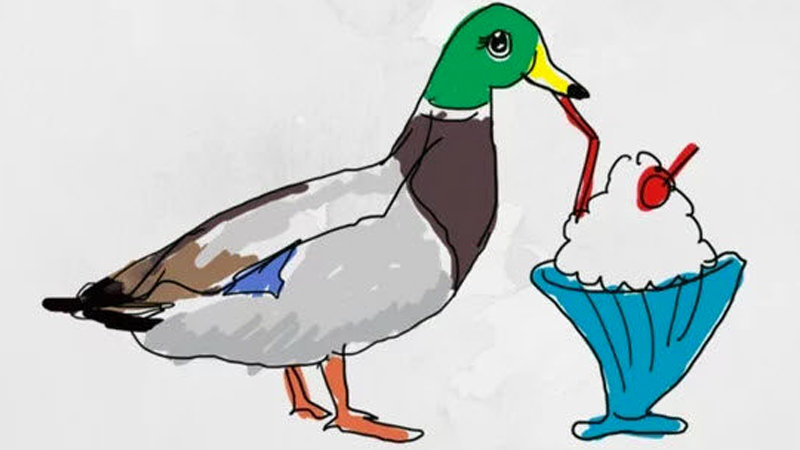
The image shows a duck drawn in a simple, almost childlike style. The bird has a green head, a yellow beak, a brown chest, and gray-white wings with a blue patch on the side; its feet are orange. Through a red straw, it sips a milkshake from a light-blue sundae glass topped with whipped cream and a red cherry. The background is light gray, without details, so attention stays entirely on the duck and the glass.
This is an illustration, not a photograph. It has no real person in it, and the meme is not tied to a specific hero. The artist cannot be identified from the picture itself; the link to the original tweet goes through the text of the joke. The viewer sees a good-natured bird, and that is the whole point: the viewer has to imagine the contrast between its cozy look and whatever may lie beneath it.
Captions that keep the rhythm
The examples are invented, built on one pattern (delight, a short turn, the outcome), and do not refer to real people.
“The new colleague helps everyone and brings cookies. A week later, his old blog was found, with a post that explained everything else.” The pair “cookies — blog” works: one detail is warm, the second is cold, and the reader fills in the transition on their own.
“The project was everyone’s favorite a month ago. Today I opened the history of its posts.” The turn here is shorter: one sentence is enough, because the word “history” already hints at the archive, while the duck with the milkshake stays serene.
“A restaurant that serves only healthy food. A photo of a receipt from a pizzeria in 2019.” The contrast between the claimed purity and a mundane detail creates comic awkwardness: a trifle looks ridiculous against a loud reputation.
“Promised not to eat sweets until the end of the month. Forty minutes ago — three milkshakes.” The transition is made through a literal link to the picture: the milkshake in the image itself becomes the evidence, and this is the shortest route to the joke.
How to use the template
The image works best for a story with a clear arc: delight, discovery, disappointment. The shorter the first part, the stronger the turn. Without a storyline, the duck with the milkshake just looks cute and does not produce a joke.
A caption should be tied to the situation, not to a specific person with a name and a place. That way the joke stays about the mechanism, not the personality, and the turn looks witty rather than mean.