Daumier's drawing in a two-slide format
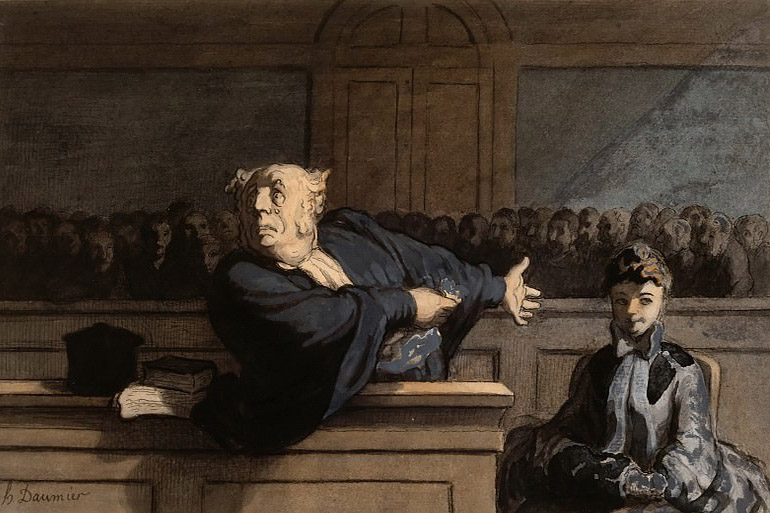
The template is said to be based on a drawing by French caricaturist Honoré Daumier, "Le Défenseur" ("The Defender"), created in the 19th century. According to the museum description, it is a drawing executed in gray ink, watercolor, gouache, and graphite. It depicts a courtroom scene: a lawyer extends his hands toward a woman sitting among the listeners or participants in the proceedings. The drawing became noticeable in short videos in April 2024, when creators began alternating a wide shot of the drawing with a close-up of the woman's face. Earlier, rarer uses also occurred, so this trend should not be declared the first meme to feature the artwork.
The color frame in circulation shows the lawyer spreading his arms wide toward the woman on the right, with several more figures in the courtroom in the background; there is no caption or modern text on the image itself. From this frame one can only read the defender's gesture and the onlookers' reaction — everything else is left to the caption.
The "here's my argument" gesture
In its online version, the pointing lawyer turns into a person presenting evidence, sharply objecting, or theatrically redirecting attention to the culprit. The second frame, when present, allows for the woman's reaction to be added. The comedy depends on how mundane the reason for such a solemn gesture turns out to be. Captions sometimes tie the scene to gender stereotypes, but the template also allows for a neutral joke about an argument where the reasoning has suddenly become too emotional.
It's important not to project the meme audience's interpretation onto Daumier. The drawing belongs to his graphic work and the courtroom satire of his era; by itself it does not illustrate the modern discussion of "female logic." Such commentary is a later use that can reinforce a sexist stereotype.
Examples of courtroom pathos in everyday life
A fitting caption: "When the neighbor claims you ate his pizza, but the box is in your fridge." The lawyer's gesture turns a petty dispute into a solemn presentation of evidence. For two slides: first a wide shot with the text "I'm explaining why you can't start a show from season five," then a close-up of the woman saying "My friend already watched the finale." The joke rests on the gap between a grandiose defense of a position and an obvious mistake.
Another example for a group chat: "When you ask for proof and get a twenty-minute story from someone's childhood." Here the gesture points at the speaker themselves and turns the conversation into a courtroom performance. The captions are made up for illustration, not historical lines from the people depicted.
Target the argument, not the gender
In a short edit, keep the direction of the lawyer's gesture visible and use the caption to explain exactly what fact he's demonstrating. For two frames, you can start with the accusation and end with the recipient's reaction or an unexpected piece of evidence. For a single image, a line like "when you present your one and only screenshot" works well. It keeps the theatricality without turning the woman in the drawing into proof of someone's stupidity.
The meme is sometimes used for mocking generalizations about women. If the goal is a joke about an absurd argument, show a specific situation and don't pass off prejudice as observation. The work itself does not depict a modern trial and does not confirm that the woman shown is guilty of anything; plot details should not be invented from a facial expression.