The 1915 poster
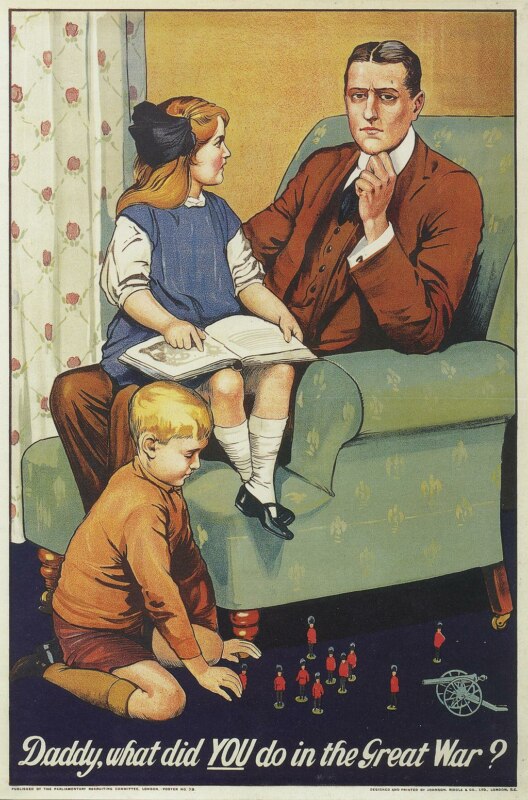
The poster was issued by the Parliamentary Recruiting Committee in London in 1915 and is listed as number 79 in its series. It was drawn by the artist Savile Lumley. The printer and designer named on the poster is the firm Johnson, Riddle & Co.
According to museum collection descriptions, the idea belonged to the printer Arthur Gunn, who then passed it on to the committee. The exact number of copies is not given in the available descriptions.
Context: recruitment through guilt
At the start of the war Britain did not introduce conscription: it came only in 1916. Until then the army was filled with volunteers, and recruitment posters tried to persuade men to sign up of their own accord.
This poster uses indirect shame: the viewer is meant to imagine how, years later, his children will ask him and what he will be able to answer. Museum descriptions note that the pressure here is built on emotion. Assessments of how effective this approach was differ: some researchers believe the shame worked, while others think it may have repelled part of the audience.
What the poster shows
At the center is a green armchair in which a man sits in a brown jacket with a dark bow tie. He rests his hand against his chin and looks seriously at the viewer. On his knee sits a girl in a blue apron with a bow, and she has an open book on her lap. On the floor a boy in an orange sweater plays with red toy soldiers, and next to him lies a toy cannon. At the bottom is the inscription “Daddy, what did YOU do in the Great War?”, where the word YOU is underlined and emphasized.
All the figures are arranged so that the gaze moves from the daughter’s question to the father’s silence. The meaning of the poster lies in this pause: the father does not answer, and the viewer must answer for him. The toy soldiers on the floor add irony: the child plays at war, while the adult avoids it.
The poster’s fate and internet versions
The poster later became one of the most recognizable images of British recruitment in the First World War. The Australian War Memorial calls it perhaps the most memorable British poster of its kind. Reportedly, soldiers hung copies in their dugouts and wrote their own answers to the daughter’s question beside them.
Online, the scene has been remade many times: the question is kept the same, while the occasion is replaced with an everyday one. The exact dates of individual internet versions cannot be established, so it is not worth speaking of specific waves of popularity; it is enough to note the principle of such remakes.
Caption examples
“Daddy, what were you doing when the Wi-Fi went down at home?” The child’s question keeps the poster’s solemn tone, but the occasion becomes domestic. The weightier the intonation and the smaller the cause, the stronger the effect.
“Daddy, what were you doing while I was waiting for the pizza?” The solemn form of the question collides with a minor occasion and gives a short release of tension.
“Daddy, what did you do when someone in the chat just wrote ‘ok’?” The question takes on the scale of a historical interrogation, even though the subject is a single message, and that is exactly what is funny.
All three captions follow one scheme: a serious question, an important tone and a mundane cause. What is funny is that an epic frame suddenly serves a trifle, so the caption should stay as short and dry as the scene itself.
How the template works
A staged family scene reads as a serious question, and this is the template’s main resource. The comedy arises when the place of war is taken by an everyday occasion while the form of the question stays the same.
Since the poster is a document of wartime propaganda, its original meaning should be kept in mind when using it. The joke rests on contrast, not on condescension toward those who fought.