What is visible in the frame
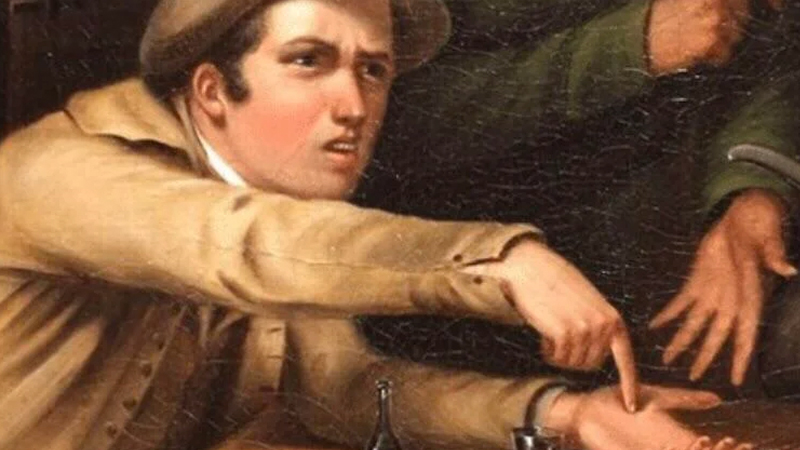
The crop is cut from a larger scene. A young man in a beige coat and a soft flat cap leans forward, brows knitted, one corner of his mouth pulled down, his face a mix of indignation and bewilderment. With an outstretched arm he points his finger downward at the back of a hand resting on the table. On the right you can see the edge of a green sleeve and another hand with its fingers spread open.
At the bottom you can make out the neck of a bottle and the edge of a glass, so the scene apparently takes place at a table during a meal or drinks. The surface of the painting is covered with fine cracks in the paint layer, which is noticeable even in a small crop. The dark background and warm earthy tones heighten the tension of the moment. The cause of the dispute is not visible in the fragment, and it is precisely this lack of explanation that leaves room for captions.
Where the painting comes from
Publications about the meme name the source as "The Village Politicians" by the American artist John Lewis Krimmel. The title repeats an earlier well-known work on the same subject by the Scottish painter David Wilkie, and because of the matching titles the two works are often confused. For a caption, it is enough to know that this is early nineteenth-century genre painting showing a heated argument at a table.
Exact details of the painting's creation and storage should be checked against the museum description rather than meme overviews. They do not matter for the template itself: only the expressive face and the gesture work.
How the crop became a template
The earliest known use is recorded in posts on English-language social networks, but the exact date of the first publication and the author of the crop have not been established. The general direction is known: a fragment of a museum painting was turned into a reaction to a minor injustice.
The typical structure is simple. The top line reads "Someone:" followed by a trivial action, and the painting responds with an emotional overreaction. The viewer instantly registers that the anger is out of proportion to the cause. Sometimes a second line adds an explanation, but the core joke is always the gap in scale.
Caption examples
Four examples written independently.
"Someone: crunches chips in a quiet library." A small sound is treated as a personal insult, and the face in the painting confirms that the outrage is genuine.
"Someone: asks you for gum even though they said yesterday they didn't need it." A small injustice grows into a matter of principle, and this is the main device of the template.
"Someone: reminds you that you owe them five bucks." The concrete, trivial sum sharpens the contrast: the smaller the cause, the more noticeable the expression on the face.
"Someone: put the mug in the wrong place." An everyday trifle becomes a conflict, and a finger pressed against the table looks like irrefutable evidence.
How to use the template
For a caption, pick a cause that is familiar to most viewers and don't overload it with backstory. If the joke needs a long explanation, the frame stops working: it rests on a single phrase and a single gesture.
The painting is old and the people in it are fictional or long unidentified, so the frame is safe for self-deprecating humor and everyday sketches. But do not use it to portray a specific real person as greedy or quarrelsome: then the joke turns into a personal attack.