How a basketball line ended up at the children's table
Artist Chilik published the comic on June 2, 2018. The punchline of the original version used the line «За себя и за Сашку» (“For myself and for Sasha”). It came from the sports drama Going Vertical (Dvizhenie Vverkh), released in 2017, in which a coach addresses basketball players with an emotional appeal. In May 2018 BadComedian elaborated on this scene in detail, and the movie's motivational line became material for independent jokes.
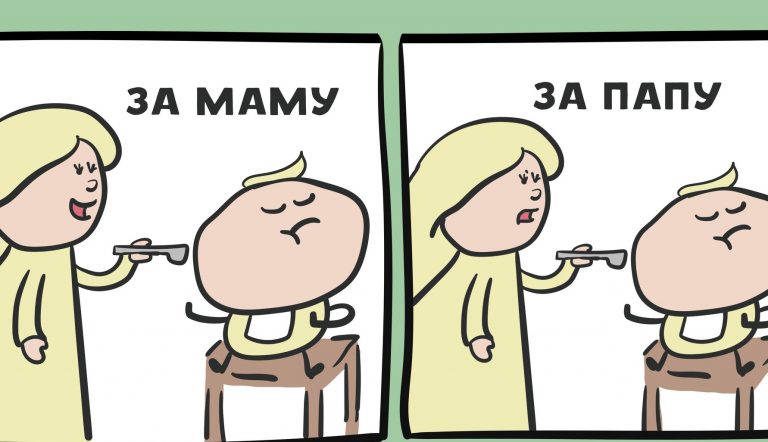
A review by Evgeny Bazhenov appeared on May 30, and then the line was carried into situations far from basketball. Chilik combined it with the domestic ritual of feeding. In the full comic, after two refusals, the child unexpectedly swallows the spoon together with the mother's hand. Remakes kept this twist, replacing the third line with a new reason: the template's origin is tied to a specific film parody, but its further life no longer requires a sports plot.
Two spoons before the punchline
The image shows only the first two panels. A light-haired woman in a light dress offers a spoon to a toddler sitting in a wooden high chair. The child closes his eyes and grumpily pushes his lips together; a white bib is visible beside him. Above the scenes, large text reads “For Mom” and “For Dad”. The greenish frame and nearly identical poses link the two attempts into one repeated action.
This crop shows the preparation of the joke, not its ending. There is no third appeal yet, nor the enormous open mouth of the punchline. Repetition lets the viewer notice the absence of a result: only the name of the person for whose sake the food is offered changes. For a viewer familiar with the format, the two panels work as an unfinished phrase after which one mentally wants to add an unexpected reason to agree.
Why the last argument is stronger than the first
The comic turn is built as a sharp change in the scale of the reaction. Mom tries different words for the same everyday task, the child remains unmoved, and then a single motive turns the refusal into exaggerated enthusiasm. The literal content of the spoon does not change. Only the frame in which the hero perceives the action changes, so the third line reveals his funny personal priority.
The setup transfers easily from food to studying, work or entertainment. In such a remake the toddler becomes a generic person whom nothing can interest, and the mother becomes the voice of the persuader. The phrase about family creates a familiar intonation of persuasion; the ending collides it with a completely different desire. Sometimes a modest reason is especially funny, one for which the character shows more energy than for any solemn promises.
What could be in the third spoon
In an invented student version, the first attempt sounds like “For a good grade”, the second “For a future career”, and the third “For the right not to open a textbook on the weekend”. The last one promises immediate rest, so it can be linked with the lively reaction. The comic mocks the difference between a distant benefit and a small reward that suddenly makes the task desirable.
Another invented variant is addressed to a board game enthusiast: “For order on the table”, “For the guests' comfort”, “For a place for the new box”. Tidying becomes attractive as soon as it serves a hobby. And in a joke about a cat, ordinary persuasion gives way to the rustle of a food bag: instead of a third phrase, a recognizable sound does the work. In all cases the punchline returns the familiar feeding scene but transfers its logic to new objects and desires.