An ad that became an ambush scene
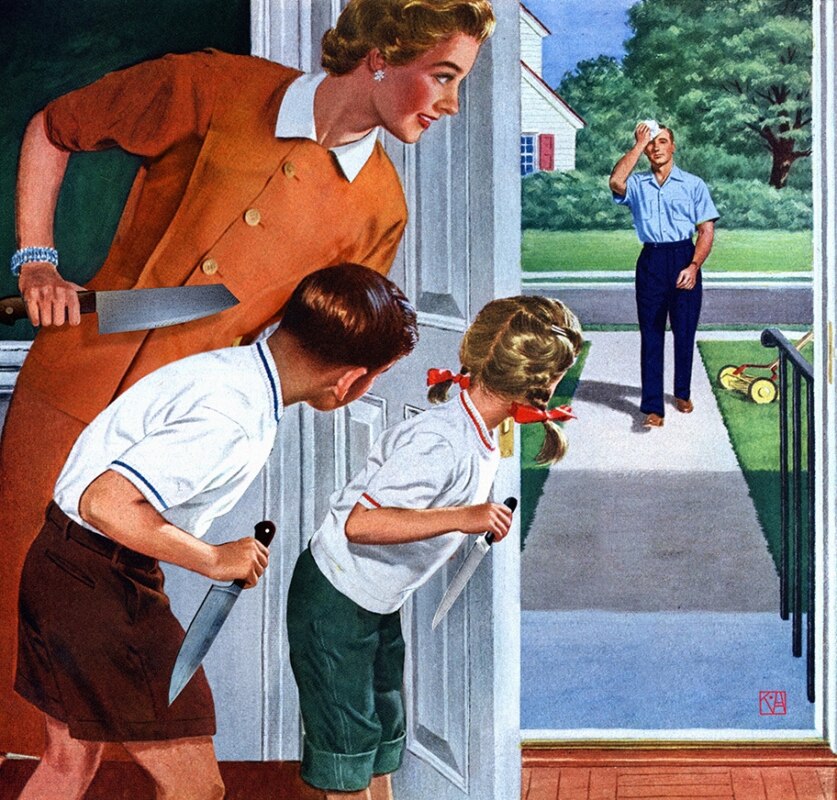
Before the knives, this was a men's clothing ad. The Arrow Casual Wear illustration appeared in LIFE magazine on June 14, 1954, under the headline “How to make Father pop… with pride!” and offered to delight Dad with new shirts for Father's Day. The mother and children are already standing at the entrance, and the father is only just approaching the house: the original drawing showed a surprise about to become a gift. The modern copy keeps the old-fashioned colors, clothing, and facial expressions, but replaces the folded shirts with kitchen knives. A single substitution is enough to turn a sign of care into a sign of threat.
From a single edit to a repeatable pattern
The earliest known knife edit is dated October 26, 2011: it was posted under the name “Ambush.” In November of that year, new variants appeared in a Russian-language Photoshop thread. These are early recorded posts, not proof of who first thought of the replacement. After several quiet years the drawing spread noticeably again in the summer of 2018, when it began to be used as a base for captions and historical comparisons. What matters in this shift is not only the effect of the old ad but also the simple geometry of the scene: the figures behind the door can be handed out to different “participants,” while the approaching father is left as the one who does not yet know about the trap.
Why the picture reads instantly
The doorway divides the scene into two groups. Closer to the viewer are the mother and two children, each with a knife; farther off, on the path, the father appears. He looks at the house and wipes his brow, while the viewer has already noticed the weapons. This creates dramatic irony: the character approaches an event the audience knows about before he does. At the same time, the drawing shows neither an attack nor an explanation of why the family took the knives. The pause before any action leaves room for a caption. In one version the knives may stand for rivals and the father for someone who confidently walks into a dispute; in another, the objects become a multitude of small problems that greet him at the threshold.
Invented captions
Imagine the evening before a project deadline. The mother is the team lead, the two children are two unfixed defects, the knives are their sharp notifications in the group chat, and the father is the developer who promised to check everything in the morning and is only now opening the door. The family already knows about the problems, while the person arriving does not yet. In another invented scene, the mother and children are the owners of an apartment, the knives are three new leaks, and the father is a repairman who approaches the door with a promise to “fix everything”: the threat becomes an urgent list of work. Finally, the mother and children could be an exam committee, the knives three difficult questions, and the father a candidate who walks in without knowing the topic. All the examples are invented; they keep the visible roles and show how one and the same threshold can mean a deadline, a repair job, or a trial.