Picture: two silhouettes and a tangle
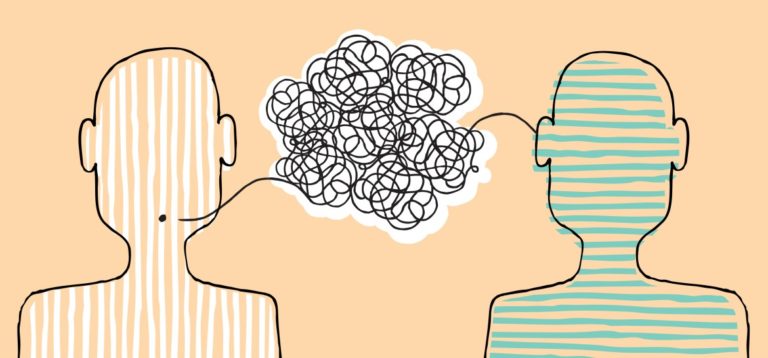
The illustration has a peach background and two outline silhouettes of people seen from behind, turned toward each other. The left figure is filled with vertical white stripes, and there is a black dot on its neck from which a thin line runs. The right figure is filled with horizontal turquoise stripes. A line from the left silhouette leads to a black tangle of looped lines outlined in white, and from the tangle a line goes to the ear of the right figure.
There is no text in the picture. It resembles a general illustration of the topic “information transfer” or “misunderstanding,” and no link to the TIL expression is indicated in it. The author and purpose of the illustration are not established, so it should not be read as the original image of the expression.
Where the abbreviation came from
The exact origin of the abbreviation is unclear. Based on search trend estimates, the expression began to spread on Reddit and Digg around April 2007. This is an approximate estimate, not the date of the first publication.
On December 28, 2008, a Reddit user created a section for short facts called TIL. The expression appeared before the section and became its name, not the other way around. In May 2011, the moderators announced that the section would be renamed “todayilearned.” The earliest known definition of the abbreviation on a slang dictionary site is dated August 20, 2009, but it is already later than the first uses.
How a TIL post is built
The formula is simple: TIL is placed at the start of the headline, followed by the fact. Usually the construction is “TIL that” followed by a statement the author has just learned and which, in their opinion, may be unknown to others. Such a headline promises a small discovery and invites discussion.
The meaning is close to the phrase “Did you know?”, but TIL emphasizes a personal moment: the author is not teaching the reader, but sharing something they have just realized. This makes the expression softer, which is why it caught on in discussions where people share finds.
Example headlines
Below are invented headlines built on the same formula. They are examples of structure, not verified facts.
“TIL that an octopus has three hearts.” A short, clear fact, and TIL immediately signals that it is news to the author. The example shows the basic structure.
“TIL that a cat can recognize its own name, but does not always feel like answering.” Here the fact is combined with a mild caveat, and the second part adds irony.
“TIL that the phrase ‘wait, I’ll be quick’ from me means at least twenty minutes.” A personal observation is presented as a discovery, and the caption is funny because of the recognizable self-assessment of one’s own unreliability.
“TIL that my phone’s autocorrect is smarter than me in half the cases.” An everyday observation is turned into a grand discovery, and the contrast between the solemn delivery and the minor fact creates the joke.
How to use the picture
The picture suits posts about unexpected finds where the exchange of knowledge matters: one person shares a fact, and another is surprised. The pair of silhouettes already conveys the idea without words, so the caption can be short.
For jokes, it is better to choose minor facts: then the contrast between a small piece of knowledge and a grand headline is more noticeable, and the text does not sound preachy.