What is drawn
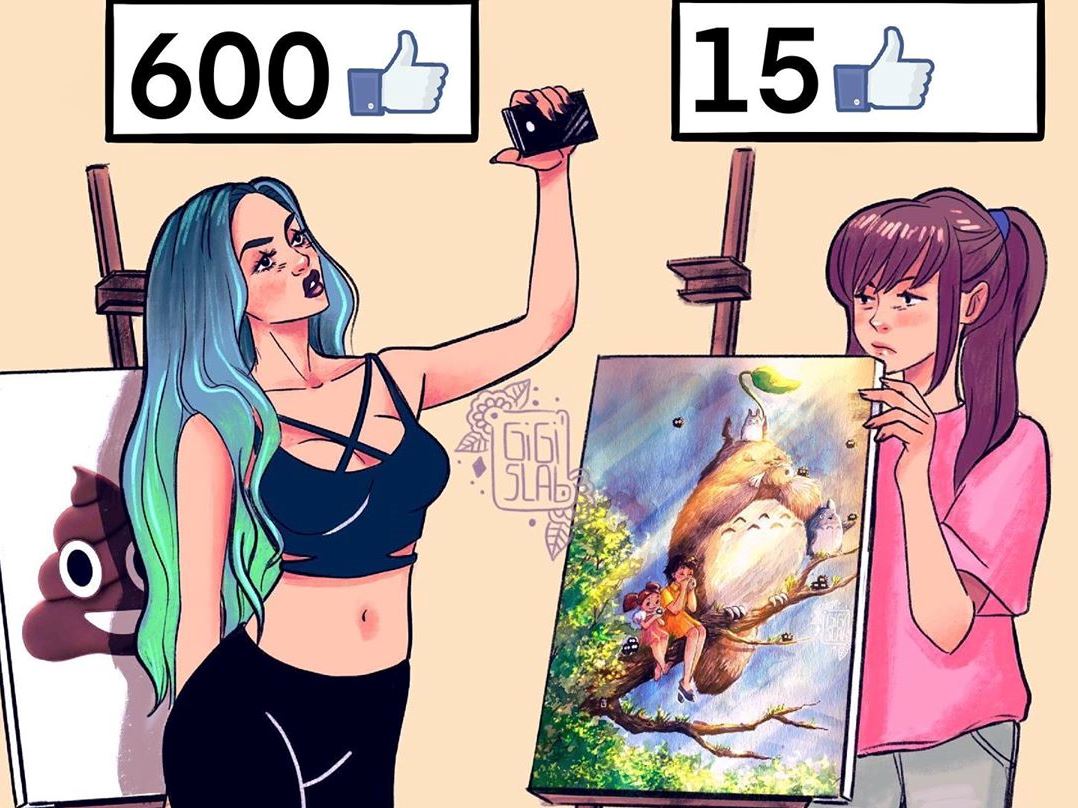
The composition is strictly symmetrical: two girls, two easels, and above each one a white sign with a black number and a blue Facebook-style “like” icon. The sign on the left says “600,” the one on the right says “15.” The background is warm, cream and peach.
On the left stands a girl with long wavy blue-green hair, dark lipstick, a black top with crossed straps, and black leggings. She holds out a smartphone and takes a selfie, with a self-assured look. Behind her, on the easel, there is a large emoji-like pile with eyes.
On the right, a girl with chestnut hair in a ponytail and bangs, wearing a pink T-shirt, holds up a large canvas in front of her. On the canvas, Totoro, the character from Hayao Miyazaki's “My Neighbor Totoro” (1988), is painted in soft colors; he sits on a tree branch, and next to him are two little girls and small black “dust” creatures. Her face is gloomy, and she is looking at her rival's sign.
Author and origin
Between the two heroines, the drawing carries a signature monogram in the form of a floral ornament with the inscription “Gigi Slab,” which is how the original is credited. Beyond that, little is reliably known about it: there is no date of first publication or platform, and the exact year of creation has not been established.
The format itself, “two characters and two numbers,” is very old and is familiar from pictures about “what is valued and what is not.” This version stands out for one detail: the girl on the right is not doing merely “boring” work, but is holding Totoro, a character everyone loves, meaning work that would be easily recognized and appreciated if she had an audience.
Why the image works
The joke is built on three contrasts: body and painting, speed and labor, 600 and 15. A selfie takes a second, while a painting takes hours. The emoji-pile in the background emphasizes that “creativity” is also present on the left, but it is deliberately empty.
It is important that the girl on the left is not a villain: she is simply doing her own thing. The joke is aimed at viewers and the feed, not at her. That is why the image is easy to apply to any social network where “quick” outpaces “made with care.”
Examples for your own caption
“A detailed review of a book: 15. A photo of coffee next to a book: 600.” The caption keeps the logic of the original: substantive work on the left, atmosphere on the right.
“A video whose editing took three days: 15. A cat sneezed: 600.” The cat takes the place of the selfie, and the joke becomes kinder, because it is impossible to be offended at a cat.
“My diploma and my joke about the diploma.” A self-ironic variant: the left heroine is the joke, the right one is the diploma.
“An open-source project after a year of work: 15 stars. A screenshot of a bug: 600 likes.” A variant for programmers, where value is not reflected in the response.
How to use it
For a remake, you change not the drawing but the two numbers and the two captions on the signs. The closer the numbers are to real ones, the funnier it gets: “600” and “15” can easily be replaced with “2.4k” and “7.”
A joke where the authors themselves end up in the role of the heroine on the right works well: many creative people have experienced hard work going unnoticed while a quick post collects thousands of marks. Avoid captions that mock the appearance of the girl on the left: the picture is about the mechanics of the feed, not about the person.