Two mice and two counters
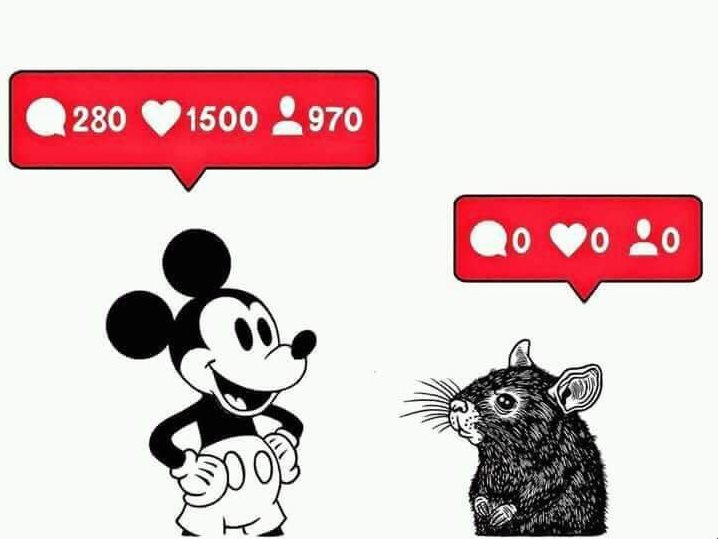
On a white background, a smiling Mickey Mouse stands on the left, and on the right is a small realistic mouse drawn in black hatching. Above each drawing hangs a red panel resembling a social network notification. Next to Mickey's comment, heart, and person icons are the numbers 280, 1500, and 970. Above the mouse, all three values are zero. The phrase “We live in a society” is not printed in the file itself.
The comparison is built so the objects look related and yet are clearly unequal in fame. Mickey is recognized by the silhouette of his ears, his gloves, and his familiar smile; the second drawing shows an animal with no name and no media biography. The counters assign both the same measure of attention. As a result, the difference between a famous character and an ordinary mouse reads as an absurd contest where the conditions are supposedly the same and the result is predetermined.
An early drawing on Twitter
One early example of this version appeared from the Twitter user @660th on May 12, 2018. The drawing of Mickey and the mouse was accompanied by the phrase “We live in a society.” Already on May 16, a report written at the time described the spread of such comparisons among users: people set alongside them TV shows, music, and other cultural objects. This trail shows the start of a noticeable May wave, though it does not establish who first drew each detail of the collage.
The red panel has an earlier visual parallel. In 2014, the artist iHeart created the work Nobody Likes Me in Vancouver: a crying boy is shown next to a notification with no reactions. The title plays on two meanings of the English word “likes” — sympathy and social media approval marks. This resemblance helps explain the expressiveness of the counter, but by itself does not prove direct borrowing of the mouse drawing or iHeart's authorship of this version.
Society as an overly serious conclusion
The phrase sounds like the start of an important argument about how the world is organized, but no explanation follows it. Instead of arguments, two pictures and numbers are presented. This leap from a small observation to a big conclusion creates the irony: the author seems to have exposed society as a whole, simply by comparing the popularity of two mice. That is why the meme can at once complain about unfair attention and poke fun at its own tendency to turn personal taste into a universal law.
The counters here are conditional. They do not show a real audience poll, and they do not prove any artistic superiority of the less popular object. Inside the joke, the zeros stand for the author's hurt on behalf of a beloved thing, and the large numbers stand for its loud competitor. The comparison is especially clear when the objects share a category: two songs, two ways of relaxing, two photographs of the same object. Then the viewer quickly understands what is being offered for evaluation and why the result seems absurd to the author.
Who gets the attention in the new scenes
In the first invented example, on the left is a photo of a perfectly round store-bought cookie with a thousand hearts; on the right, a homemade cookie in the shape of an uneven star with zeros. The caption “We live in a society” turns a kitchen grievance into cultural criticism. An extra funny note appears if the author himself ate the homemade star before anyone had a chance to see it: the lack of attention gets a perfectly everyday explanation.
In the second invented scene, a library cat lies on a closed book and collects hundreds of reactions. Next to it, the same book is shown open, with a reader's neat notes, and receives no hearts. The objects are tied together by one photographic story, but the attention goes to the lighter image. The third variant sets a beautiful empty planner against a filled-in working notebook. The formula stays recognizable, although the object of irony becomes the attractive packaging and the unnoticed everyday work.