What's shown in the drawing
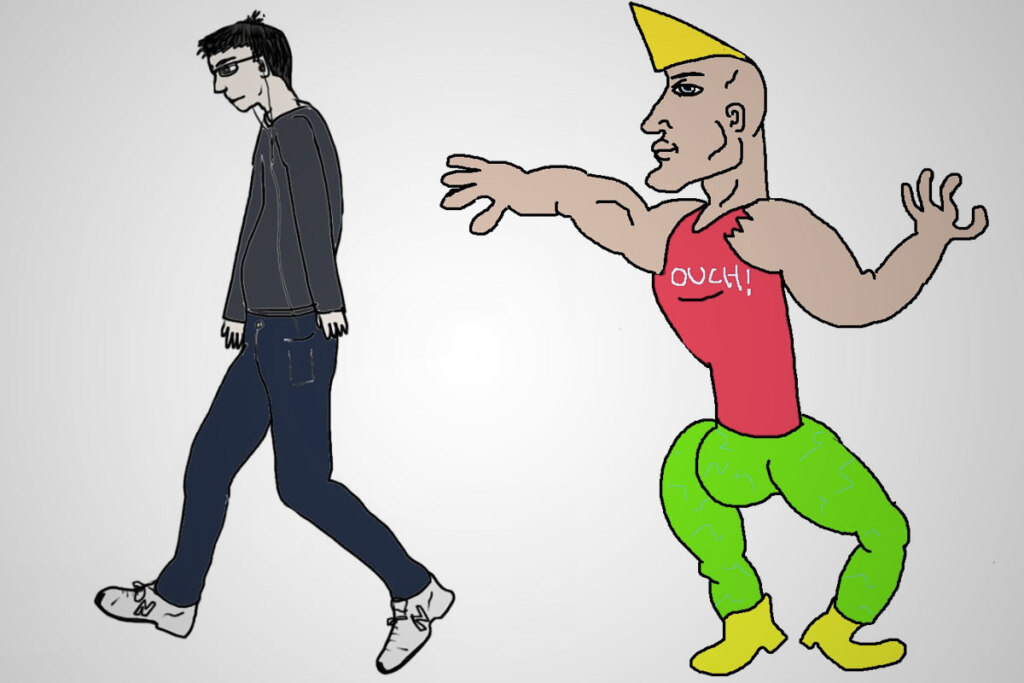
On the left is a thin man with dark, disheveled hair and glasses. He's wearing a dark hoodie, dark jeans, and white sneakers. His head is lowered, his arms hang at his sides, and his gait looks shuffling and uncertain. The character is drawn in simple lines, and small details emphasize his fatigue and awkwardness.
On the right is a broad-shouldered, bald man with a yellow mohawk, wearing a red tank top with the word "OUCH!" on it and bright green pants. His legs are set wide apart, one arm is stretched forward, the other out to the side, and his whole figure seems to project confidence. The contrast is built not just on appearance but on movement: in one case, a stoop; in the other, a sweeping stride.
Origin of the format
The idea of comparing a "virgin" and a "Chad" appeared on anonymous boards before the visual template took shape. The word Chad, used to denote a confident, attractive man, had already been in use in internet slang before this. According to available data, a verbal description of the "virgin walk" first appeared on April 23, 2016, on 4chan's /r9k/ board in a thread called "Virgin signs." The first drawn illustration was posted there on March 25, 2017.
In the spring of 2017 a version drawn in MS Paint appeared and was posted to the site FunnyJunk. In June of the same year a thread was started on /r9k/ calling for people to post "vi/r/gin" memes, and the flow of pictures grew quickly. On June 7 one of the galleries made it to /r/4chan, and on June 10 the format was being discussed on Reddit. The author of the original drawings hasn't been identified, and the origin of the "OUCH!" lettering on the tank top isn't described in the sources.
How the meme is used
The template is handy for comparing two approaches or two reactions to the same situation. For example: "when you're waiting for a reply to your message" versus "when you've already given up waiting," or "when you ask your parents for money" versus "when you get a bonus." The caption is usually short, and the main joke rests on the contrast between the poses and the attitude toward the event.
Over time the format expanded: versions appeared featuring characters from games, TV shows, and films, as well as with other pairs like "smart" and "trendy" or "optimist" and "pessimist." Within the community such pictures often serve as self-deprecation: the authors emphasize that they recognize themselves in the stooped figure and laugh at their own awkwardness.
Why the joke works
The meme is effective thanks to hyperbole. The authors deliberately push the contrast to the point of caricature, so even without a caption it's clear the subject is self-perception, not a real person. The visual language is simple, recognizable, and easily transferred to any topic, from relationships to career.
The format has been criticized for reinforcing the idea of masculinity as a set of external traits and dominance. The image of the "Chad" has often been used to mock men who don't fit standards of attractiveness. Even so, in most cases the meme is perceived as an ironic game rather than a serious statement about people.