A line from a 2003 animation
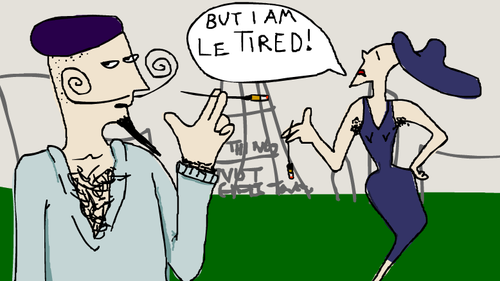
The End of the World was created by Jason Windsor, who published his work under the name Fluid. The original Flash animation dates from 2003; it later spread widely through eBaum's World. The illustration shows two characters and that very line; it is a separate drawing, not a frame from the animation.
In the scene, the tired hero says: “But I am le tired.” Another voice suggests sleeping first and only after sleep continuing the rocket launch. The catastrophe is not canceled by one tired character: the joke is born from a brief pause within a shared absurd plan, where the end of the world can be postponed for the sake of rest.
In the drawing, one character spreads his hands while talking, while the other stands with hands on hips. This counter-posture supports the impression of dialogue: one hero's tiredness becomes a pause for the other, not an independent decision about the fate of the world.
A deliberate linguistic mask
The French le is a masculine article placed before a noun; in the English phrase, it stands before tired in a way that breaks the rules of both languages. The error is the device itself: the speaker seems to give tiredness a foreign chic, though he complains about the most ordinary state. The contrast between the grand sound and the simple meaning makes the line easy to recognize.
Such language mixing works well for a short comic intonation, but the phrase in the drawing keeps a specific reference to the animation. Later uses of le before ordinary words may be independent wordplay; they do not turn all similar combinations into quotes from Windsor.
How the scene survived Flash
For early internet audiences, the animation was not only a story about rockets but also a set of easily quoted lines. The move from Flash players to sites with videos and shares helped the phrases live apart from the original dialogue. In 2018, Windsor released a sequel about the split in American politics and Donald Trump, moving the earlier apocalyptic theme into the present.
When “le tired” appears on its own, a viewer may recognize the familiar pseudo-French tone even without remembering the whole scene. In the original dialogue, this complaint serves as a brief respite within the larger plot, not a rejection of it.
The title End of Ze World already plays with the pronunciation of “the,” and “le tired” continues the same deliberate linguistic mask: a simple complaint sounds like an important declaration. Recognizability rests not on grammatical correctness but on the collision of a French article and an English phrase.
Invented captions
“Le deadline decided to show up again after lunch.” This is an invented caption: an ordinary work word gets a parodically grand foreign outfit.
“Le tea went cold while I was choosing which series to start.” This invented variant also keeps the linguistic mask, but moves it from a cosmic catastrophe to a simple everyday indecision.