What the picture shows
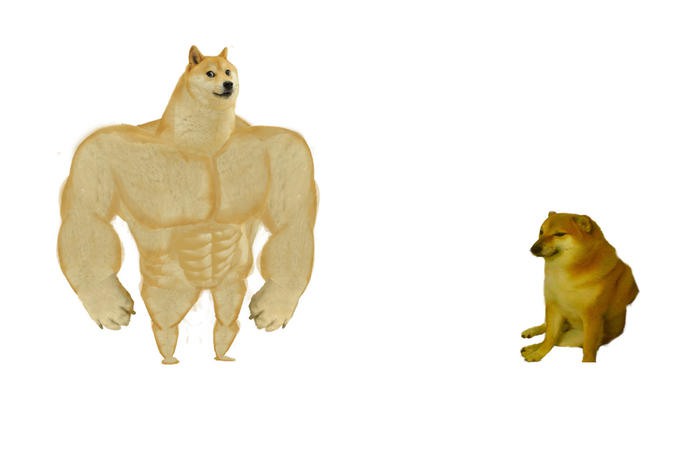
The frame is almost empty: a white background and two Shiba Inu dogs. On the left stands a Doge on its hind legs with a bodybuilder's physique: broad shoulders, a defined six-pack, huge paws. The head is an ordinary dog's head, with a slight smile, and it looks off to the side. On the right, far from him, sits a small Cheems: ginger, calm, with slightly pressed-back ears and a crooked half-smile.
The distance between the characters is part of the joke. Between them is empty space, where the eye itself places the captions and the difference in strength. The template needs no text: two inscriptions above or beside the dogs are enough.
Where the two characters came from
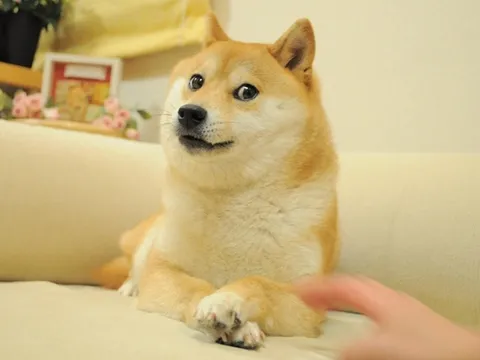
The prototype of Doge is a Shiba Inu named Kabosu from Japan. Her owner, Atsuko Sato, posted photos on a blog, and the picture with the sidelong glance appeared online in February 2010. The spelling “doge” itself goes back to an earlier internet joke: according to descriptions, it came from an episode of the 2005 web animated series Homestar Runner. Captions in broken English, like “such wow,” became Doge's signature style.
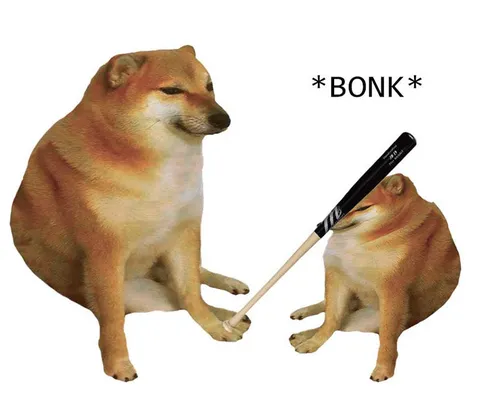
Cheems is a different dog, a Shiba Inu named Balltze. Photos of her with her owner spread online from about September 2017, and the character then grew its own language: distorted words like “cheemsburbger.” This is a separate story, not connected to Kabosu.
How they were put in one picture
According to overviews, in 2019 comics featuring Cheems appeared on Reddit in the Dogelore community, and in July of that year the first version of the picture appeared where the buff Doge stands next to Cheems. Who exactly made the original composite is unclear; the author remains unidentified.
The format spread quickly. It is related to “weak versus strong” templates: two states of one phenomenon, where the winner is on the left and the loser on the right.
How the joke works
The main thing here is not the dogs' personalities but the exaggeration. The buff character is too powerful to be true, and that is exactly what turns the comparison into self-parody: a person promises themselves to become “Doge” and ends up as “Cheems.” The right-hand character is not mean or pitiful, he is simply ordinary, so the template works as an honest confession.
The captions work both ways. You can show a decline (“before” and “now”) or the gap between grand intentions and results. If you swap the captions between the characters, the joke changes meaning: the weak Cheems becomes wise and the strong Doge becomes foolish.
Caption examples
The captions are invented for illustration. “Me who signed up for a run on Monday” above the buff dog and “Me on Tuesday” above Cheems: the distance between the pictures shows how quickly the enthusiasm faded.
“The series in season one” and “The series in season eight”: nostalgia for a good beginning, where the left figure is stronger simply because memory is always larger than reality.
“My weekend plan” and “My weekend”: a big intention against a small result, and the joke works without malice.
“Coffee after the first cup” and “Coffee after the fourth”: funny precisely because on the left is an almost mythical strength, and on the right a quiet outcome.
Tips for use
Short captions work best, one per figure: a word or a phrase. Long text breaks the contrast. Keep the right side a little more modest than the left, but not insulting: Cheems is almost always likable in this joke, and the caption should sympathize with him, not humiliate him.
If you want the reverse effect, swap the roles: on the left “trendy idea,” on the right “what actually works.” Then the muscles turn out to be a prop, and the little hero wins.