What you see in the frame
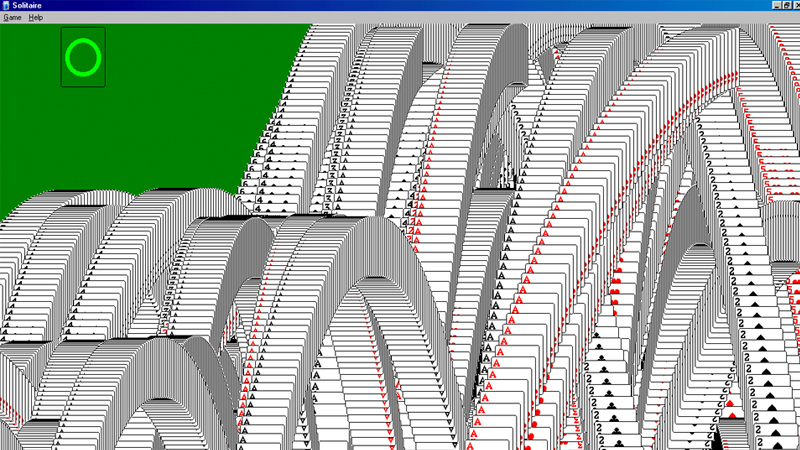
The image shows a classic Solitaire window with the title “Solitaire” and the menu items “Game” and “Help”. The upper left part of the playing field is green, and in the top corner there is a green circle in a frame, sitting where the empty stock pile would be. The rest of the screen is filled with cards that rise and fall in wide arcs and leave hundreds of copies behind them: the deck looks smeared in motion.
Letters A, the numbers 2 and 3, and red and black suit symbols are discernible on the card faces. It is this dense geometry of repeated cards that makes the frame striking: the eye cannot pick out individual cards and sees only waves.
The frame shows a process, not a finished caption. The player sees this state for only a few seconds, so the meme refers to a specific moment rather than to the game as a whole.
A game where winning looks like a celebration
Klondike, known in Windows as Solitaire, came bundled with Windows 3.0 in 1990. The game was written by Microsoft intern Wes Cherry, and the card backs were drawn by designer Susan Kare. For many years the game was part of the system's standard set of games, and for millions of people it was their first computer game.
When the player collects all 52 cards, they take turns flying off their places and bouncing off the window edges. The bright trails appear because the program does not erase a card from its previous position while it moves. The result is a wave of hundreds of imprints: a side effect of drawing has become the most recognizable moment of the game.
This is an important detail for understanding the meme. The game itself is monotonous: dragging cards and trying to lay out the deck. The animation creates contrast: after the routine, the system throws a short salute, and it is this sharp transition that became the subject of jokes.
Why the caption “When You Win” works
The format rests on two things: a small occasion and a huge visual response. The caption names an ordinary situation, while the picture shows it as if an important event had happened. The viewer immediately notices the gap between the scale of the occasion and the scale of the reaction.
There is also a nostalgic layer. Many people know the game from old computers, and the frame of flying cards brings that feeling back. That is why the meme is understood even by those who have not opened Solitaire in a long time.
Caption examples for your own template
Below are independently invented captions. Each uses the same frame but changes the occasion.
“When I found the keys I had been holding in my hand.” The example works through contrast: the find is minor, but the picture looks like the finale of a tournament. The funny part is that the person was looking for something obvious.
“When I sent the report five minutes before the deadline.” The caption describes a tense but successful finish, and the fireworks turn sending a file into an almost sporting event.
“When the soup didn't burn, and I didn't even try it, so as not to jinx it.” The second part adds an unexpected twist: a celebration for a result that has not been checked yet.
All variants rely on exaggeration: the more modest the occasion, the funnier the frame.
How to use the template
Use the frame where there is a contrast between a small event and a big reaction. The shorter the caption, the easier the frame reads: one line with a clear occasion works better than a long explanation.
Avoid captions that turn the frame into a serious victory when the real result is unclear. The meme rests on light exaggeration, and when the occasion is too serious, the joke sounds out of place.