How a "boomer" turned thirty
The template took shape on 4chan in spring 2018. First, text captions about “that 30-year-old boomer” appeared on /biz/, then the Brainlet Wojak drawing joined them, and later the version in glasses with a Monster settled in. In surviving discussions the hero already speaks about cryptocurrency in the tone of someone who caught it “while it was still cheap.” These are early traces of the format, not proof of who invented the character or first drew each detail.
The word “boomer” here deliberately does not match the age. In its ordinary sense it refers to the baby boomer generation, but the meme transfers the label to a person around thirty: young enough not to be a boomer on the age scale, and old enough in teenagers' eyes for his habits to become a target of mockery. This very mismatch forms the first twist: the dispute is not about the date of birth but about how quickly other people's tastes turn into “old stuff.”
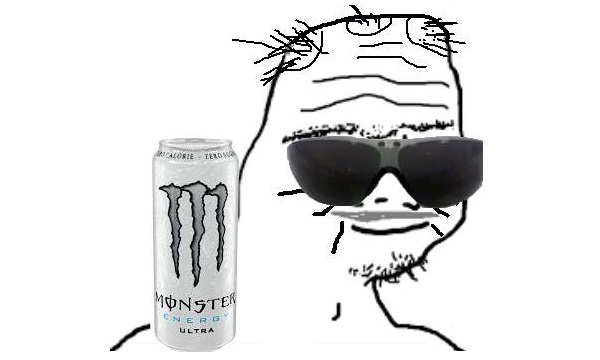
By early summer 2018 the formula was already circulating on /biz/ and in gaming discussions. Crypto, old shooters, VR, and the habit of treating one's own experience as the final answer became variations of one role. In the image the character is brought to a recognizable emblem: a balding forehead, a smirk under the glasses, and a big energy drink can. This is not a portrait of a real person or a description of all people at thirty, but a caricatured set of markers assembled into one recognizable type.
Invented caption: “That very thirty-year-old boomer who is sure that Quake III is still the best way to find out who can play.” What matters here is not the choice of an old game but the intonation: a preference is presented as the objective outcome of history. If you replace it with a favorite console, band, or drink, the construction keeps the same mockery of confidence that fails to notice that generations have different tastes.
Why Monster is in the frame
The can works as a short sign of the everyday lifestyle the meme ascribes to the hero: energy drinks, games, internet arguments, loud nostalgia. The contrast lies not in the drink being funny in itself but in how an ordinary thing becomes part of a carefully assembled character. The grin adds smugness, but the meaning does not reduce to an accusation of bad taste: the viewer sees how one set of hobbies is declared a sign of an entire generation.
That is why the frame can be read both as teasing and as self-irony. The caption may mock an older forum member who disdains anything new, or it may sound in the voice of the lover of old games himself: “yes, that's me, and I'm fine with it.” In that case the same soldier-type stops being an external label and becomes a mask that a person puts on himself.
Invented captions: nostalgia without an age test
“That very thirty-year-old boomer who sets up the old Windows startup screen and says technology went the wrong way after that.” The caption turns an ordinary attachment to a familiar sound into a claim of historical rightness.
“That very boomer who buys a new game to explain why the old ones were better.” The loop here is funny: the person still follows new releases but uses them in advance as a reason to confirm his own nostalgia.
“That very boomer who asks to bring back the buttons on the remote and then complains that the menu is too complicated.” The example pits love for a simple device against resistance to any change, without the need to attribute this habit to all people of a certain age.
From a character to a jibe word
Later the word “boomer” came to be used far more widely than the original hero and turned into a short reply to a preachy or conservative tone. 30 Year-Old Boomer keeps a more precise picture: this is not simply an older interlocutor but a young adult whose tastes are already mocked as outdated. When a caption keeps a specific habit — crypto, an old shooter, a favorite drink — the image stays precise. If you remove it and leave just a single “boomer,” the comic paradox of the number thirty and the age label is lost.