From a gaming term to a gray avatar
NPC is short for non-player character, a game character whose actions are set by the program. In July 2016, the gaming board /v/ on 4chan was already using the term as a metaphor for people who supposedly repeat memorized lines. In the fall of 2018, a gray version of Wojak appeared on the political board /pol/: the expressionless face came to depict a supposed “person without a thought of their own.”
Later that same year, the meme became part of the American election debate. In October, supporters of Donald Trump created Twitter accounts for an NPC roleplay game; after they posted false information about the election, the platform suspended more than a thousand accounts. The online comparison to a computer character thus moved from a metaphor about thinking habits to a political insult.
An identical crowd and different readings
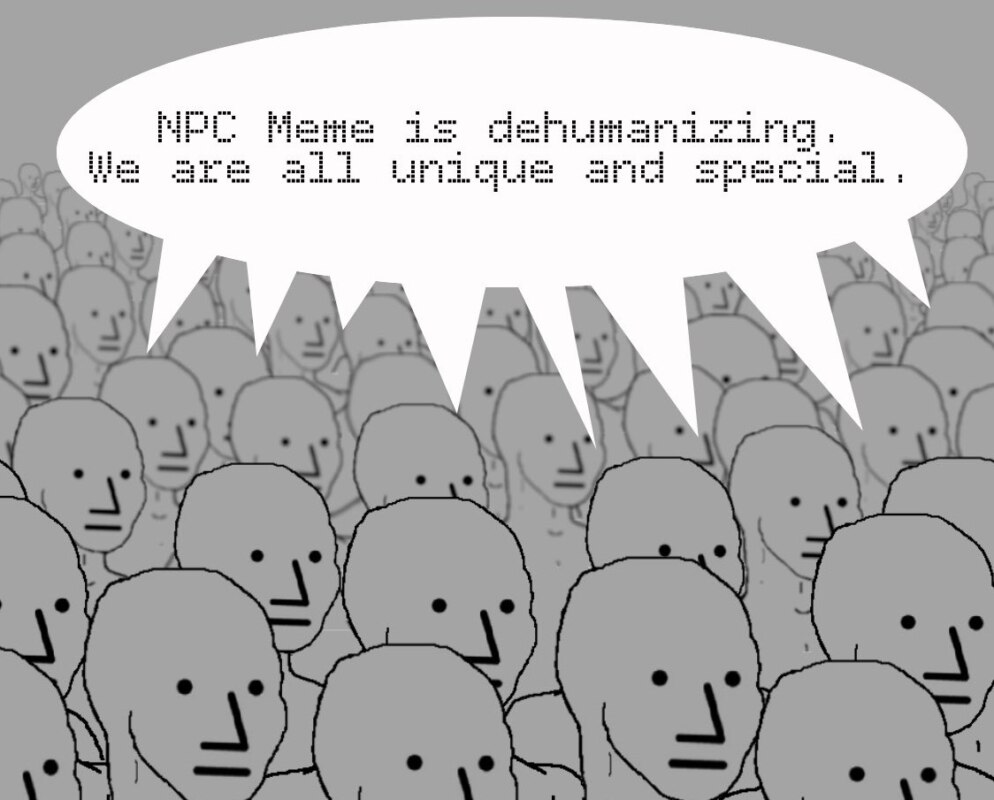
In this version, the gray faces are gathered under a shared speech banner: they claim that the NPC meme depersonalizes people and insist on their uniqueness. Tension arises between the picture and the words. One can see irony: a chorus of identical figures states a thesis about individuality, seemingly confirming the accusation of sameness. The image can also be read as a retort to those who reduce a political opponent to an impersonal game character.
These readings do not allow one to confidently assign a single goal to the creator. The image itself supplies material for both interpretations, because the visuals and the text argue with each other. In one case the viewer laughs at a rhetorical paradox; in the other, they notice how an argument about “herd mentality” can easily turn a living person into a caricature.
Invented captions
“When the chat decided to discuss how everyone is different and repeated it in unison.” A caption like this highlights the mismatch between the identical crowd and its statement. Another option: “We are not a faceless mass, wrote the group account of the course.” Here the group statement itself becomes a source of light self-irony. These are invented examples, not historical quotes.
The political context can be kept without making a whole group the target: “When the argument is no longer about the decision, but about who will call the other an NPC first.” Here the joke aims at a repeated move in a squabble. The picture can even do without a new line: its own banner already sets up the argument, and the extra text merely determines how ironically the viewer reads the identical faces.
What the game comparison means
In a game, a non-player character is part of a constructed world: it may offer a quest, repeat a line, or move along a set script. Online, this word transfers that technical convention onto a real conversation partner and hints that they have no inner decision-making of their own. That is why the political NPC meme can be either a plain mockery of identical phrases or a way to deny an opponent the right to an independent position.
Wojak's gray form makes this argument quick to recognize, but a single drawing does not reveal which party or person it is pinned on. On the contrary, an image with a line about uniqueness shows how one and the same template can be used to build opposite remarks. Its humor comes from the contradiction between identical faces and a claim of individuality; the political tint depends on who is speaking, who the joke is aimed at, and how the banner is read.