What the challenge is
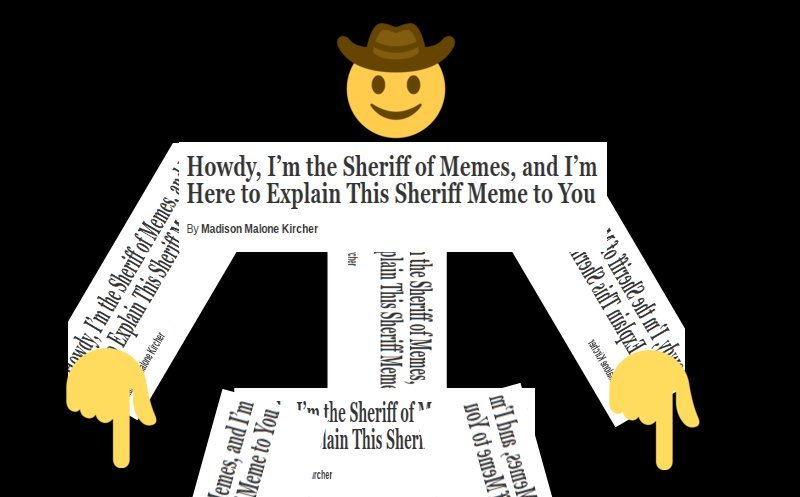
At the heart of the challenge is the sheriff emoji — the face wearing a cowboy hat — which was added to the Unicode standard in 2016 along with other emoji of faces in headwear. Participants assembled a little human figure out of standard symbols: a head with a hat, gun-hands, and a body made of other emoji. The resulting character resembled a Western hero and was instantly recognizable.
Each drawing came with a caption that gave it character. Some phrases sounded like the character introducing himself, others like a short story. The combination of visual image and text made the challenge popular: it was easy to repeat, and the results always turned out different.
History of its spread
The challenge gained popularity in 2017, when users on Twitter and other networks began massively posting their own versions. The exact date of the first post and the author of the idea have not been established. The meme developed in waves: first in English-speaking communities, then in Russian-language groups, where it was translated and supplemented with local jokes.
Journalistic pieces about memes played an important role. One article, in which journalist Madison Malone Kircher jokingly "explains" the emoji sheriff himself, spread across newsrooms and discussions and helped cement the image associated with the challenge. Such publications showed how internet humor crosses over into media and back again.
Why the jokes worked
The meme's main mechanism is the contrast between the tiny and the serious. A minuscule emoji figure behaves like a Western hero, and solemnity combined with everyday captions produces a comic effect. Users often used the sheriff to describe their daily life: work, exhaustion, and relationships.
The format worked well for experimentation. You could swap the hat for other headwear, add weapon emoji or props, creating whole series. This way the challenge turned from a single drawing into a set of characters with their own stories.
Significance for internet culture
The challenge shows how emoji became a tool for creativity. A set of symbols created for messaging was used as a construction kit for drawing. This anticipated many later formats where users assembled images out of icons and smileys.
For the Russian-speaking audience, the meme became an occasion for its own creativity: people captioned sheriffs with lines from films, songs, and local jokes. In this way the foreign challenge was adapted to a local context while keeping its main principle — instant recognizability and play with form.
Legacy and current status
Today the challenge is considered one of the early examples of emoji memes. It's no longer discussed as something new, but the sheriff image remains recognizable and occasionally returns in the form of individual images and references. It's a reminder that internet humor is often built on very simple means.
The details of the first publications, including their dates and authors, are not known.
Over time the challenge developed separate branches. Some participants tried to draw the sheriff as neatly as possible, matching symbols by size and color, while others deliberately made the figures rough and clumsy, and it was often this second approach that produced the funniest results. In this way, different creative approaches coexisted within a single format.