What it depicts
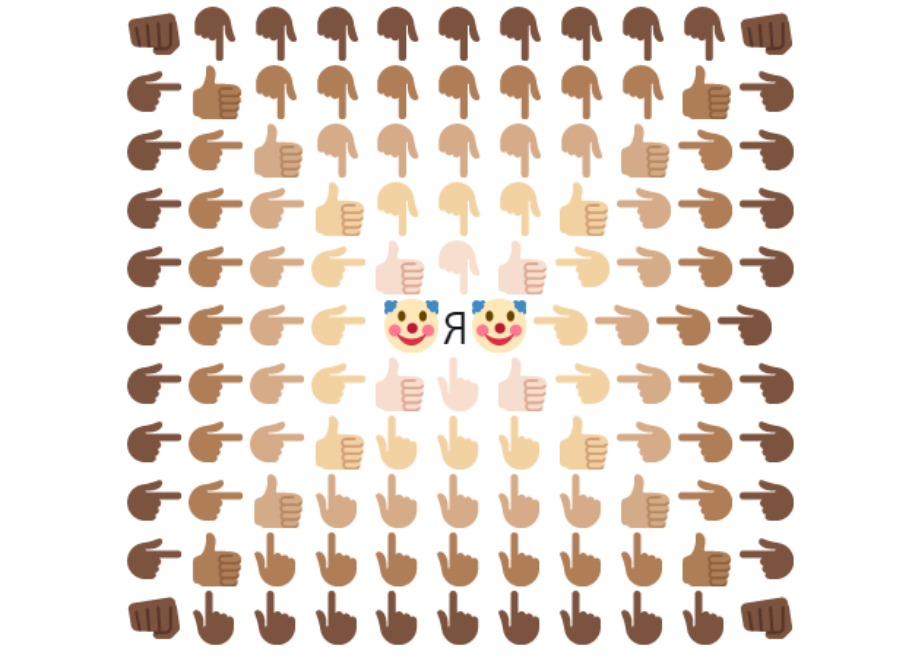
The picture consists of a neat grid of emojis. The basis is pointing index fingers: at the top and bottom they point down and up, on the left and right they point toward the middle, so everyone is looking and pointing at one spot. Skin tones change gradually: dark brown at the edges, getting lighter toward the center. Among the fingers there are some thumbs-up, and four fists stand in the corners.
In the center is the caption “I” surrounded by two clown emojis. It is exactly this that turns the pretty pattern into a joke: all the hands in the world point at the one who admitted to being a clown.
What the pattern is made of
The clown emoji 🤡 appeared in the Unicode 9.0 character set in 2016, while the ability to change skin tone on gestures came earlier, in Unicode 8.0 (2015). The template rests on two details combined: the clown as a long-standing symbol of “a person who made a fool of himself,” and the grid of fingers, which turns a personal confession into a collective finger-pointing.
Who first assembled this square is unknown, and no exact date is given. It is only clear that the idea is simple and easy to repeat: you just copy the emojis in the right order and replace the word in the center.
How the joke works
The picture is built like a little scene. The author puts himself in the spotlight in advance, and the fingers are the gaze of the people around. The more fingers there are, the stronger the feeling that the condemnation is universal. But the caption “I” makes it self-irony: nobody accuses the hero from outside, he himself points at his own mistake.
That is why the template suits stories about your own blunders: you believed some obvious nonsense, fell for the same old trick again, promised yourself for the hundredth time to start on Monday. The laughter comes from recognition: everyone has been at the center of such a square at least once.
Examples for your own caption
Instead of “I” in the middle you can write a short phrase. “I, who once again believed that tomorrow would be easier” — the fingers point at a familiar self-deception.
“I, who made a neat plan for the week and did not complete a single item” — the joke works through hyperbole: one slip-up and a hundred pointing hands.
“I, who wrote to my ex yesterday” — here the clowns hint that the author understands it all himself.
“I, who bought a subscription for the sake of one movie” — a down-to-earth everyday situation in which it is easy to recognize yourself.
How to use the template
The caption is best kept short: a couple of words in the middle are read at once, while a long phrase will break the symmetry. The template works best for stories about yourself. If you apply it to another person, it stops being self-irony and becomes a direct accusation, and the meme loses its softness.
Make sure the center does not get lost: the pattern is pretty on its own, and the text must be readable against the light emojis. A successful joke is one where the reader immediately understands what the author did, and the clown faces merely confirm it.