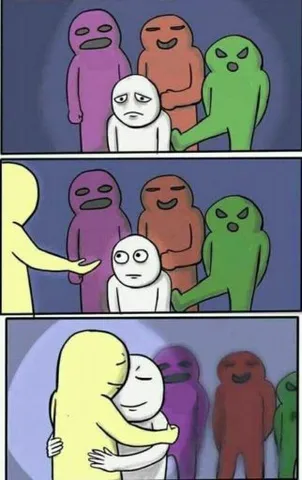
Meaning of the term
“Normie” (from the English “normal” or “ordinary”) is a dismissive label for everyday internet users who take in and share memes superficially, without digging into their original context, history, or a given community’s in-jokes.
Such a user shares a picture because it struck them as funny or because it was already popular, not because they understand where it came from or what it originally meant. The word usually carries a mild sneer rather than real hostility. It is more a light jab at someone who doesn’t know the context than an insult.
Contrast with the memenuts
The term is set against “nonconformists,” or “memenuts” (меманутые) in Russian, meaning users who follow meme culture from the inside. They tell originals apart from derivative remakes, appreciate complex jokes, and get irritated when a simple version goes mainstream.
The split between “normies” and “non-normies” reproduces a more general us-versus-them divide familiar to any closed online community. A similar logic shows up in fan, gaming, and music subcultures, where longtime members set themselves apart from those who arrived later, after the topic had already peaked.
Origin and dates
The internet slang “normie” took hold in English-language imageboard communities in the 2010s, from where it gradually spread into wider use, including in Russian-speaking internet.
The exact date of the term’s first use is not documented, so the word’s appearance cannot be pinned to a specific day or post. It is more accurate to speak of the slang gradually settling into everyday online culture. The word apparently reached the Russian-language internet as a calque from English rather than through independent invention.
Template and examples
For a long time the term had no fixed visual template. The word was used as a short comment caption under any screenshot of already widely shared content: “This got old ages ago, but normies just noticed” or “Typical normie taste: liking what everyone has already seen.”
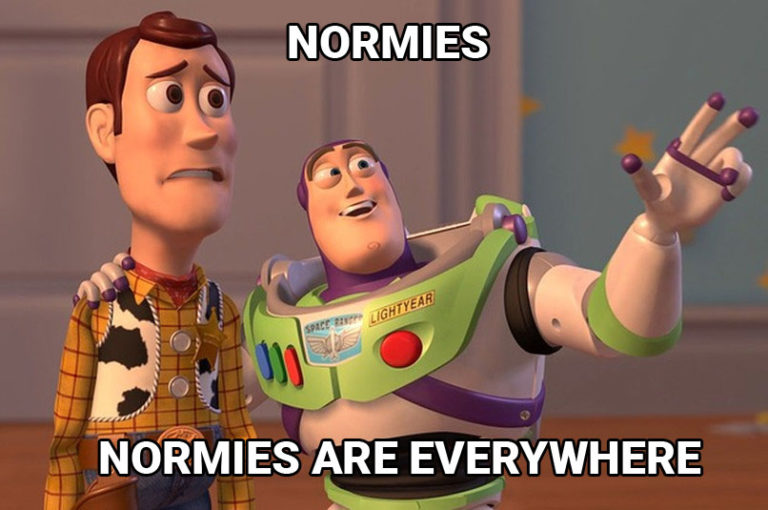
A ready-made image template later emerged too: frames from the cartoon *Toy Story*, where one character points at another with the word “NORMIES,” and a caption below reads “NORMIES ARE EVERYWHERE.” The variant is used to ironically point out how widespread something mainstream is in one’s surroundings, by putting any phenomenon the author finds too popular or overplayed under the top line.
Why the term is contested
Using the word often draws pushback. Critics of splitting people into “normies” and “those who get it” accuse the labelers of snobbery and of artificially sorting people into two camps based on their familiarity with internet jokes.
For that reason the term is sometimes used ironically, including toward people who take their own “non-normie” status a little too seriously. In that self-deprecating use the word loses its original insulting function and becomes more of a playful self-description than a tool for sorting people into groups by how deep their interest in internet culture and its inside jokes goes.