What lies on the floor in this frame
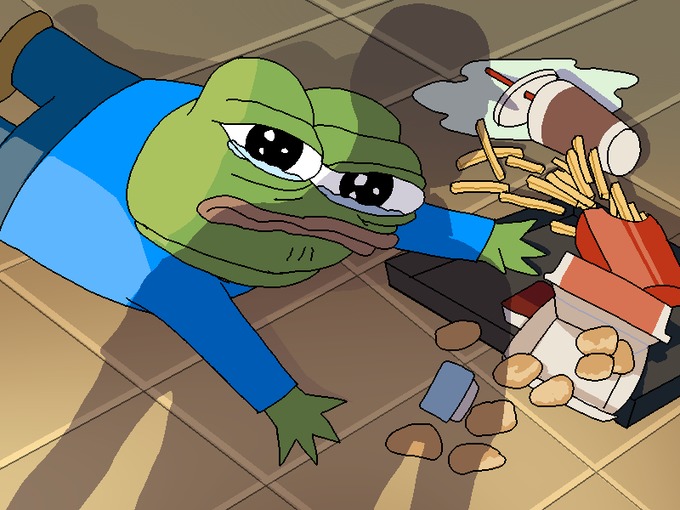
The picture shows a frog character in a light blue hoodie sprawled on a floor of beige tiles. Tears fill its eyes, its mouth turns down, and one arm reaches toward the tray that has flown aside. Scattered around are fries in a red carton, nuggets from a cardboard box, an overturned cup with a straw and a puddle of drink. A large dark shadow lies across the tiles: someone is standing over the character, but that person is not visible.
This is a drawing, not a still from a film or cartoon. The frog is done in the deliberately crude manner known as Apu: a large head, sad eyes, outlines that look hand-drawn.
That tray of food
According to an English-language meme encyclopedia, the drawing was first posted by an anonymous user of the 4chan imageboard, in the /biz/ board, on 25 March 2021. The author has not been identified. In the same weeks the picture circulated on other boards, while a noticeable jump in popularity came in the middle of May 2021, when people began making remixes of it on social networks.
The English title, Apu Spills His Tendies, is built on the word “tendies,” a playful childish term for chicken nuggets. Hence the Russian-language version, “Apu uronil naggetsy” (“Apu dropped the nuggets”). It is worth remembering that the date of the imageboard post and the time of mass spread are different things, and the post found does not prove that the drawing could not have appeared somewhere earlier.
Why it’s such a pity for him
The joke rests on the mismatch between scale and grief. What is lost is neither a car nor money but a fast-food meal, yet it is presented as a personal catastrophe. The shadow above adds a second note: the hero has not simply been knocked over, someone is standing over him and watching. That is why the template easily turns into a scene with two roles, a victim and an observer.
Apu’s tears do not refer to anything specific about real people. This is a conventional emotional gesture used to say: it stings, and over something trivial.
There is a third detail: the food. Fries and nuggets are the simplest and most recognisable joy, almost childlike. When they lie on the floor, the viewer needs no explanation of the scale of the tragedy, even though in essence it is a trifle. A trifle cast as a tragedy is the engine of the joke.
Examples of captions and analysis
“Me when the coffee arrives in a bag instead of a cup.” A small everyday loss is presented too seriously, and the whole drawing works on this contrast.
“The season’s final episode dropped, and I’ve already watched it all.” Here the tray is replaced by a pleasure that ended earlier than it should, and the same feeling comes through: everything was just here, and now it’s gone.
“They said there would be a bonus, then showed the numbers in a spreadsheet.” An example of adult disappointment: the frog on the floor conveys the blend of childlike naivety and disillusionment.
“Me when I wanted one more helping, but the plate was already washed.” It fits small everyday injustice well, because the hero is already lying down and the shadow above is always ready to become the second character.
How to use the template
A caption works best when it is short and specific: naming the small loss is enough. If you want a second role, caption the shadow, for example as a boss, a parent or simply “reality.” Use the picture where the upset is exaggerated and therefore funny; if the situation is genuinely serious, the drawing will sound out of place.
The drawing is convenient for a vertical crop around the frog and the tray, but it is better to keep the shadow in the frame, otherwise the second role disappears.
Another way is to split the picture into “before” and “after.” In the first half the character is happy with the tray; in the second it lies on the floor. The joke then gets a setup and a payoff, with the drawing serving as the payoff.