Plot of the comic
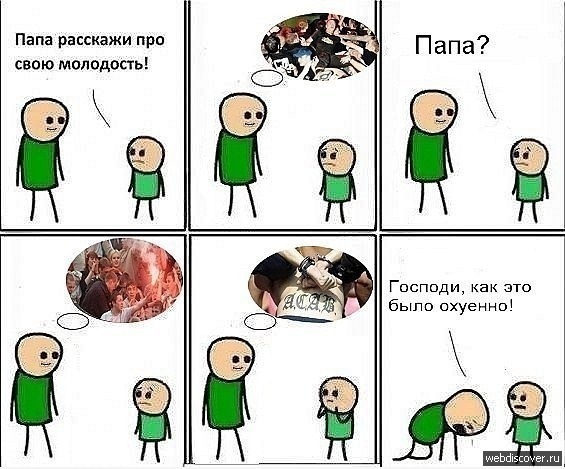
The comic consists of six panels, and each follows the same pattern. A boy asks his father to tell him about his youth, and the adult pauses to think. In the thought bubbles, scenes appear one after another: a loud party, a crowd at a concert, a vivid mass brawl, and a tattoo reading ACAB. The abbreviation stands for "All Cops Are Bastards" and is usually associated with protest subculture.
A short third panel with the line "Dad?" interrupts the adult's reverie. In the final panel, the father doubles over with delight as he recalls the past: "God, that was fucking awesome!" The shift from reminiscence to delight and back to the child's confusion forms the main comic pairing.
Cyanide and Happiness
Cyanide and Happiness is a web comic drawn in a simple stick-figure style, known for its dark humor and abrupt storylines. It was created by a group of authors associated with the site Explosm; its founders are usually listed as Kris Wilson, Rob DenBleyker, Matt Melvin, and Dave McElfatrick. The series began in the mid-2000s and quickly gained popularity in the English-language internet.
The year 2004 listed in the catalog refers to the dating of this particular adaptation specifically, and the exact date of the episode's original publication was not established. The Russian-language version circulated as images bearing the watermarks of the sites that posted them, which was typical for memes of the 2000s and early 2010s.
How the joke spread
In the Russian-speaking segment of the internet, the comic caught on thanks to translation and reworking of the lines. The phrase "Dad, tell me about your youth" became a recognizable cue for irony: it's used in comments whenever a conversation turns to the past, or when adults unexpectedly reveal their old escapades.
The joke's format is easy to repeat because it's simple to rebuild: just swap out the pictures in the thought bubbles, and the joke takes on a new context. That's why the comic often appeared alongside photos and videos tied to youth culture, and each time it was read as a separate reference.
Structure of the humor
The main mechanism of the joke is the contrast between expectation and reality. The child expects an edifying story but instead gets a hint at excesses the adult would apparently rather not discuss. The viewer understands that the father is remembering something inappropriate for a conversation with a child, and the laughter comes from that awkwardness.
The joke also relies on a plot familiar to everyone: parents who behaved differently in their youth than they do now. Such stories are understandable to audiences of all ages, and the comic is read sometimes as family irony, sometimes as a nod to generational culture, where protest and parties serve as symbols of growing up.
Attitude toward the subject
The comic belongs to the category of memes that don't mock a specific person. The father character serves as a type rather than a real individual, which is why the joke remains harmless and adapts easily to any context, from family settings to student life.
The episode is preserved in meme archives as an example of how an English-language comic got a second life on the Russian-language internet. The history of its translations and reposts shows that the joke's success was determined not by the accuracy of the translation but by how recognizable the situation itself was.