What is visible in the frame
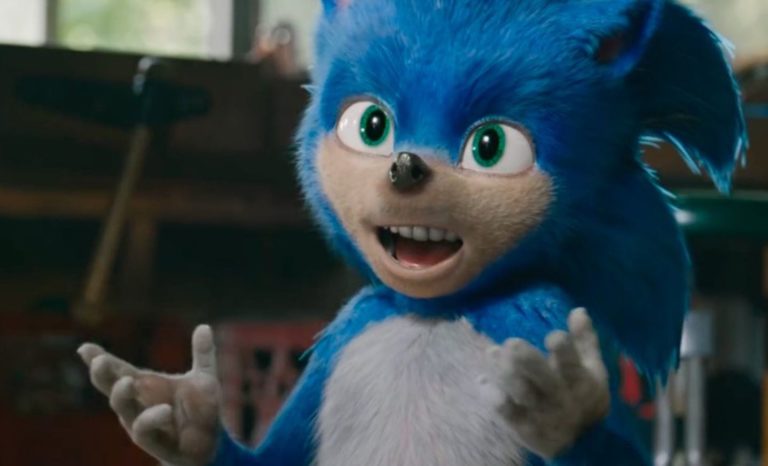
The close-up shows a blue hedgehog with thick fur, a light muzzle and a white chest. The eyes are round, with green irises and light highlights; the mouth is open, showing a row of white teeth and a dark cavity. The arms are raised forward, palms up, as if the character is in the middle of a story or argument. The background is blurred: it looks like a workshop or garage with wooden surfaces and tools.
The frame looks like a scene from a film rather than a concept or drawing. So the key in the picture is not the render quality but the facial expression: it looks both emotional and unnatural, and that is exactly what sparked the discussion.
The trailer and first reaction
When the first trailer came out on April 30, 2019, viewers immediately noticed the small body, disproportionately large eyes and teeth. Fans began calling the character “Ugly Sonic,” and the name spread quickly across social networks.
Two days later, director Jeff Fowler publicly acknowledged the criticism and promised changes. The design was reworked before the film's release, and the character received a look closer to what long-time fans expected. The film came out in early 2020. Later the old design appeared in the 2022 comedy *Chip 'n Dale: Rescue Rangers* as a joke about itself.
Why the joke works
The main mechanism is the contrast between expectation and result. Viewers know the character from the games as a stylized hedgehog with fast movements and a simple silhouette. When a creature with realistic fur and human teeth appears on screen, perception cannot decide whether it is an animal or an actor in a costume, and awkwardness arises.
Captions usually build on this pause: the frame already reads as “oof,” and the text adds the conclusion. That is why the meme outlasted the criticism itself: the same image fits any situation where the result looks different from what was promised.
Caption examples and how they work
Example 1: “I ordered the fast hero from my childhood and got a hedgehog who explains why it is not to blame.” Here the expectation is speed and charisma, while the text shifts attention to justification, and the character's facial expression suits that well.
Example 2: “Waiting for the build at work to finally work, and I already have twenty tabs open.” The character with the open mouth becomes a standard reaction to a situation where expectation diverges from reality.
Example 3: “When they said the design would be redone, but there is still no deadline.” The meaning rests on the frame's reaction already resolving the situation without further explanation.
Example 4: “Me on Monday, when I realized yesterday was not a day off.” The short phrase at the end adds everyday context, and the frame works as exaggeration.
All captions are built the same way: first the frame sets the emotion, then a short phrase turns it into a concrete situation. If the text becomes longer than the reaction itself, the joke is lost.
How to use the image
The frame is better applied to situations where the result did not match the promise, not for mocking a specific actor or the creators. Here the target of the joke is the design, not a person, and captions should address the expectation rather than the performer's appearance.
If you need a precise reference, it helps to mention that this is the early design, not the final one. Then readers who know the history of the redesign will get the joke, and those who do not will get the context from the caption itself.