Conversation before the fight with Thanos
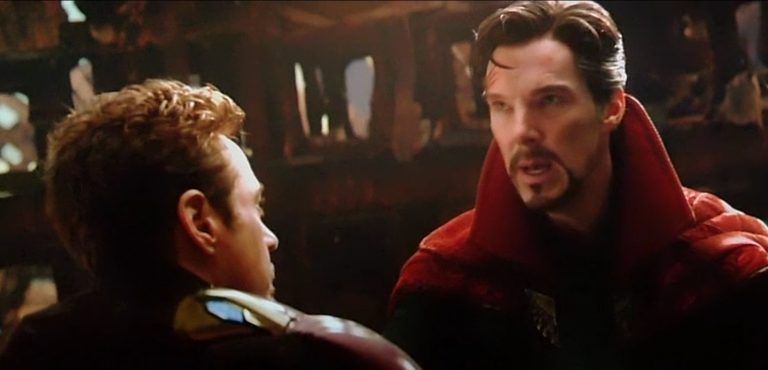
The film “Avengers: Infinity War” by the Russo brothers, Anthony and Joe, was released in American cinemas on April 27, 2018. Benedict Cumberbatch plays Doctor Strange, and Robert Downey Jr. plays Tony Stark. In one scene Strange looks at the possible outcomes of the coming fight with Thanos. When Stark asks about the number of victories, he replies that only one successful outcome exists among the 14,000,605 futures he saw.
Meme remakes of this exchange appeared as early as May 2018. Among the earliest documented posts is a collection of jokes about the film on Imgur from May 15; the scene was also used on Twitter in the same period. Later the variants spread on Reddit. These traces show the early life of the format but do not prove the name of its single inventor. For a new joke, people kept the large number of possible outcomes and replaced the question about defeating Thanos with another one.
One frame of an imagined dialogue
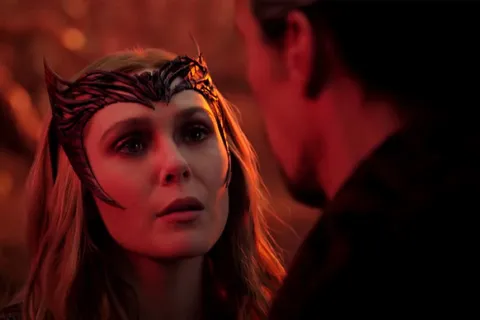
In the picture Strange is placed on the right: he wears a red cloak and faces Stark. On the left, the head and part of the armor of his interlocutor are visible from behind. The warm dark background and the mage's serious expression preserve the dramatic atmosphere of the film. There are no ready-made lines here or division into three panels. A single frame represents the whole conversation, which the viewer can recall or reconstruct from the new caption.
In the widespread expanded version the scene is split into three steps: the report on the futures viewed, Stark's question, and Strange's brief answer. The last panel completes the joke. A single frame suits the more compressed form, for example a message reporting the result of a long calculation. The red cloak and Cumberbatch's face tie such a caption to a character who truly has an unusual way of knowing the future, rather than just making a confident forecast.
A huge number and a small hope
The precision of 14,000,605 gives the absurd calculation a businesslike look. It is not a vague “a million possibilities” but something like the result of a meticulous check. After such an introduction the viewer expects a thorough explanation. Instead, they get one word or a small number. The contrast between the enormous volume of knowledge and the extremely short conclusion makes even an ordinary disappointment feel like a cosmic catastrophe.
The answer “one” keeps a tiny hope alive, so it suits an almost unbelievable success. The answer “none” closes off the expectation completely and makes the joke sharper. One can also use an unexpectedly large number: then the mage confirms that the nuisance will recur in every case. These are different turns of the same dialogue. The number serves not as real statistics of an everyday event but to convey the hero's emotional certainty that he has already gone through every possible way to get what he wants.
Invented questions from Stark
First invented dialogue: “In how many futures did we pick the movie before the pizza got cold?” — “In one.” It turns a drawn-out choice into an almost impossible joint victory. In a second invented variant Stark asks how many times one can assemble a wardrobe without finding an extra screw. Strange answers: “Not once.” The last word becomes the comic punchline after a serious statement about millions of checked variants.
The third invented example reverses the direction of expectation: “In how many futures will someone ask for the Wi-Fi password right after arriving?” — “In all of them.” Here the calculation promises not rescue but the inevitability of a familiar question. The first two jokes rest on a shortage of happy outcomes, the third on an excess of identical ones. The scene stays recognizable thanks to the roles of the interlocutors: one hopes to get a convenient answer, the other has knowledge too detailed to support that hope.