The argument began before the premiere
Ahead of “Avengers: Infinity War,” people discussed the scale of the meeting of familiar Marvel characters. The 2018 film brought together the Avengers, the Guardians of the Galaxy and other heroes of the shared cinematic universe against the threat of Thanos. This idea easily fit into a loud claim of an exceptional crossover. The meme shaped it as a conditional Marvel line, after which the user would present their own counterexample.
Among the known early posts from March 2018 is a tweet by Bobby Palmer, @thebobpalmer. He set against the big superhero event “That’s So Suite Life of Hannah Montana,” a meeting of characters from several Disney Channel series. Users then recalled other on-screen crossovers, old television programs and unexpected joint appearances by celebrities. What mattered was the structure of the reply: the promise of an unprecedented scale was contrasted with a beloved, forgotten or deliberately silly encounter. The phrasing lived on as a repeatable meme line; it does not need to be understood as a verbatim quote from official promotional material.
Many faces in one composition
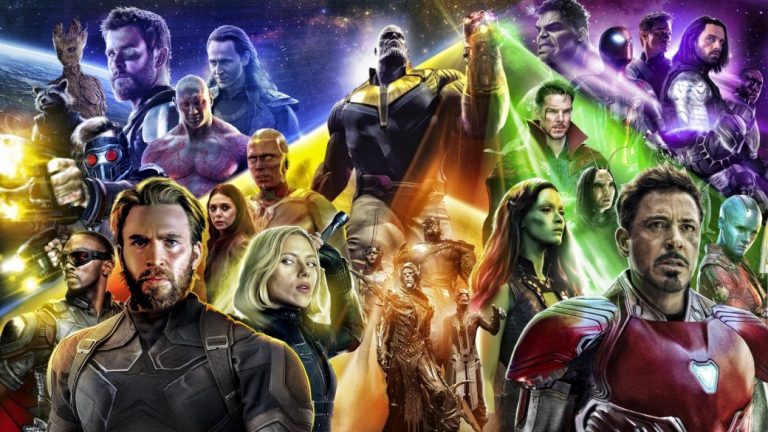
The picture gathers the characters of “Infinity War” against a bright cosmic background. At the bottom, the bearded Captain America and Iron Man in red armor are shown large. Above them is Thanos; around them are other heroes, among them the green Hulk and Gamora. Colored beams and flashes tie the individual portraits into a dense ensemble composition.
There is no caption reading “Marvel: … Me: …” and no second image with a rival. The illustration represents the large cast of the original film, that is, the first half of the mental comparison. The variety of faces makes the scale visually clear: the viewer recognizes people from several stories who have now ended up together. The reply part of the meme can be far more modest than this composition; it is often the difference between the solemn presentation and the proposed opponent that creates the joke.
Pathos collides with personal cultural memory
A crossover combines characters or elements from different works in one story. The meme uses the concept more broadly: an unexpected photo of two acquaintances, a joint advertisement or a domestic coincidence also receives a grand title. In this usage, a claim of a record becomes deliberately excessive. A small encounter looks more important than a huge film only within the author’s personal frame of reference.
The format has two close directions. The nostalgic reply recalls a real old crossover that once seemed incredible to the viewer. The absurd reply declares a meeting of universes what is usually not described with such a word at all. In both cases, the repeated opening line sets a high bar, and the second line comically overvalues it. The caption argues with the scale of the advertising expectation but does not have to mock the quality of the film: what usually amuses is the recognition of one’s own unexpected favorite.
When completely different worlds meet
In an invented scene at a school fair, a space-suit costume sits beside the apron of a pie seller. The caption announces that this is the most ambitious crossover of the space program and the snack bar. The participants do nothing unusual, but the solemn language turns the accidental proximity into an intergalactic event.
Another invented version shows a grandmother’s television, on which a new game console is running through an adapter. The reply to the loud formula reads: “When grandpa’s equipment met a cloud save.” What comes together is not film characters but different habits and generations of devices. The comedy is sustained by the photograph itself, an old casing with a new game world on the screen.
The third example depicts a household cat that lay down on a physics textbook and a cookbook at the same time. The author writes that the long-awaited meeting of quantum mechanics and dumpling recipes has finally taken place. The scale of this cultural event is entirely invented by the caption. The animal’s simple position becomes an argument against the very idea of measuring surprise by the number of stars on a poster: for a particular viewer, a funny meeting of familiar things can turn out to be more memorable.