what's in the picture
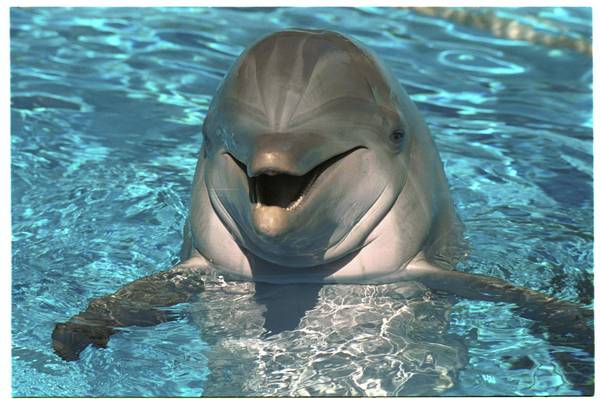
The photo shows a close-up of a bottlenose dolphin with its head raised above the water in a pool. The animal is grinning widely, its eyes and the soft outline of its head are clearly visible, and the blue water creates a bright background. The shot looks good-natured and calm, which makes it a convenient contrast to the ironic caption.
In memes, this kind of picture usually doesn't carry a plot on its own. Its job is to look smug and smart, as if the dolphin already understands everything and watches people with a kind of regret. The proportions of the face and the wide grin create a sense of friendliness, so the joke lands softly and doesn't come across as mean.
origin and history
A link between the phrase and a literary tradition is plausible, but no direct original source has been established. Most often in this context people cite Douglas Adams's novel "The Hitchhiker's Guide to the Galaxy" (1979), where dolphins are shown as noticeably smarter than humans, and in the sequel "So Long, and Thanks for All the Fish" (1984) they leave Earth, leaving behind a farewell message.
The exact date and author of the first short formulation of this as a meme have not been established. The book's imagery may be the source of the idea, but it hasn't been possible to confirm with a direct quote exactly where this short phrase comes from. So the origin of the meme in this particular form should be considered unestablished. This kind of meme format usually doesn't call for fact-checking: what matters is that the comparison sounds convincing, not that it's scientifically accurate.
how it's used
Usually the phrase is used in response to a pointless argument, or after yet another absurd piece of news. The caption follows a simple pattern: people do something stupid, and the dolphin, who doesn't do that, turns out to be smarter.
Sometimes the meme becomes a joking comment on mass stupidity in comments sections, on pointless arguments online, or on the habit of repeating the same mistakes. In that context the dolphin acts as a silent judge, and its silence makes the mockery stand out more. In chats, the phrase often accompanies a photo or video of animals, as if the dolphin itself is commenting on human chaos. This kind of use underscores that the joke rests on the image, not on a storyline.
why the meme works
The joke relies on the image of the dolphin as a friendly, curious creature that seems to understand everything. The smile in the photo reinforces the impression that the animal is watching people with condescension, which is why the caption sounds convincing.
The meme works through a simple comparison and is easily transferred to any situation. You don't need to know the book or the source of the phrase to understand that its author is being ironic about human overconfidence. This kind of humor is self-deprecating, because every viewer recognizes themselves as one of the "people" being mocked.
It also matters that the meme isn't aimed at a specific person: it mocks abstract stupidity, so it doesn't create unpleasant associations and is easily used in everyday speech. The phrase also draws on the longstanding idea of dolphins as animals with complex behavior and social bonds, which makes the comparison plausible to a wide audience. That's why the phrase comes across as a joke about people rather than a claim about the animals' actual abilities.