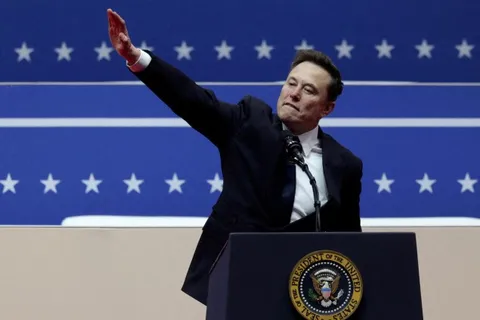
What the photo shows
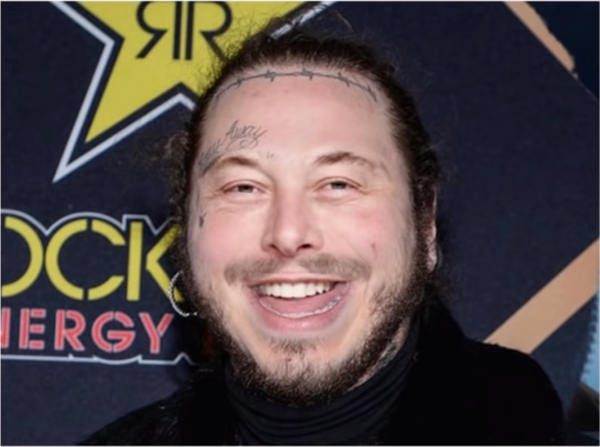
The frame is cropped close to the face. A man with a beard, mustache and hair swept back smiles broadly, eyes narrowed, head slightly turned. A tattoo in the form of barbed wire is visible on his forehead, along with several small inscriptions on the skin. Behind him is a dark background with a fragment of a yellow star and lettering resembling the logo of an energy drink.
The image itself does not show where the boundary lies between the original photo and the overlaid face. The person's name is not confirmed by a caption, so the meaning of the picture is better understood through the idea of the series rather than through this specific photo.
How the device works
The face-swap photoshop rests on a simple mechanism. When a familiar face is placed on someone else's body or into someone else's scene, the viewer immediately sees the gap between the familiar expression and the new context. The same person in different frames looks confident, then bewildered, then too pleased, and that is exactly what makes the collections recognizable.
Public figures often become heroes of such collages, because they have many well-known photos, and their public statements and projects provide material for captions. In the case of this entrepreneur the topics are electric cars, space plans and the habit of making loud claims on social media.
It is important to distinguish two layers. The first is the visual montage itself, where the face is moved into another frame. The second is the caption, which explains why it's funny. Without a caption many such pictures remain simply strange: the viewer sees the seam but doesn't understand what it's about.
What remains unestablished
When this particular picture appeared and who its author is are unknown: the series grew from many independent works by different people. The first photoshop cannot be named, so it is reasonable to speak of a mass trend rather than a specific date.
Do not attribute to the picture details that are not in the frame itself: neither the origin of the tattoos, the place of shooting, nor the reason for the laugh in the photo is reliably known. The facial expression conveys the viewer's emotion, not necessarily the person's mood at the moment of shooting.
Examples of captions
“Promised that everything would work out in a month, and for now just smiling at the camera.” The caption plays on the hero's habit of loudly announcing deadlines that then slip, while the wide smile reads as a confidence that the deadline itself does not back up.
“The rocket hasn't even landed yet, and I've already explained everything on Twitter.” The narrowed gaze turns into the pose of someone commenting on an event before it happens, a recognizable trait of loud claims about space plans.
“Another presentation, and once again ‘this will change everything.’” The contrast between the pathos of the phrase and the ordinary squint in the frame creates a joke about the habit of presenting any news as the main event.
“The electric car is almost ready, just needs to drive.” The smile looks like an attempt to keep up confidence while the promised deadline is pushed back again; the caption rests on a familiar pattern of loud announcements.
How to build your own captions
Photoshops with public figures are easiest to read as commentary on well-known words and deeds. If a caption is built on invented details of someone's private life, the joke quickly stops being about the hero and turns into a discussion of other people's guesses. It's better to rely on general situations and understandable images.
One device is enough: take an everyday situation and add an unexpected continuation. Then the picture stays funny and the text doesn't go beyond the bounds of the game. Short captions work better than long ones, because the facial expression in the picture already conveys the main point.