Game frame and someone else’s chat
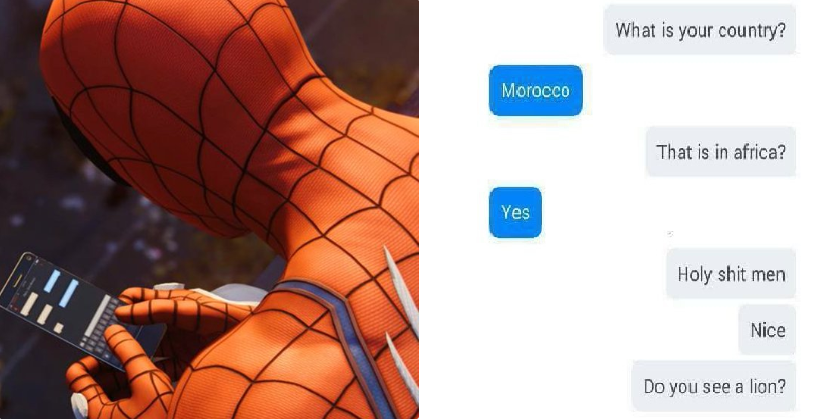
The left side of the image shows Spider-Man in his suit: he holds a smartphone and looks at the screen. On the right, on a white field, are gray and blue message bubbles. The reply about the country is “Morocco,” then the other party asks whether it is in Africa, expresses surprise, and finally asks whether the addressee can see a lion. The conversation imitates a messenger interface, but it is laid over the game frame and is not a dialogue from the game.
It is precisely the gap between the heroic image and the mundane phone that creates room for a short story. The character has a recognizable suit and pose, but inside the chat there could be anyone: a friend, an acquaintance, or someone trying to start a conversation. Here the geographic clarification turns into a caricatured, superficial picture of Africa: as if the name of a continent were enough to expect a lion right by the interlocutor.
How a screenshot became a chat
Marvel’s Spider-Man from Insomniac Games came out on PlayStation 4 on September 7, 2018. In one scene Peter Parker uses a phone in his suit. Within a few days this image was already being turned into a joke about a dating app, and then fictional messages began to be placed beside it. Early popular variants quickly showed that the screen in the hero’s hand could be read as an invitation to a separate miniature.
Gradually the chat became an independent format: the image on the left barely changes, while the whole punchline comes together from a few lines on the right. Variants could refer to the superhero world, but could also be about jealousy, everyday absurdity or a pointless acquaintance. This version uses the familiar screen as the basis for an everyday riddle, and the unusual sequence of questions and answers makes the chat a self-contained joke.
The rhythm of an awkward introduction
The exchange is short and visible in full. After the country’s name come a clarification about the continent, a surprised “Holy [expletive] men,” a terse “Nice,” and the question “Do you see a lion?” The last line continues the geographic theme but makes an absurd leap: an ordinary message about where one lives turns into an expectation of meeting a wild animal. The interlocutor seems not to know what to ask about an unfamiliar country and grabs the loudest associative image. What is funny is precisely this awkwardness of acquaintance, not the place where the addressee lives.
Spider-Man’s pose does not depict a specific emotion, and the text does not say who is typing the messages. The joke arises between a familiar superhero costume and a template chat that could appear in any messenger. The messages move the character from a world of danger into a world of everyday conversation, where an awkward question can fill the whole screen.
Invented conversations
Invented example: “Are you at the library yet?” “Yes.” “Then save me a seat next to the dinosaur section.” Here one simple question instantly turns into an absurd, specific request; the motionless hero with the phone looks like an intermediary between a completely ordinary message and a small quirk.
Another invented chat: “Can you cook?” “Only tea.” “Great, we have a soup contest today.” The punchline does not depend on the spider or his abilities: the costume merely amplifies the mismatch between a superhero and a minor everyday situation. In the first case the comedy rests on the sudden request; in the second, on the absurd assignment of a new role to the interlocutor.