What is in the frame
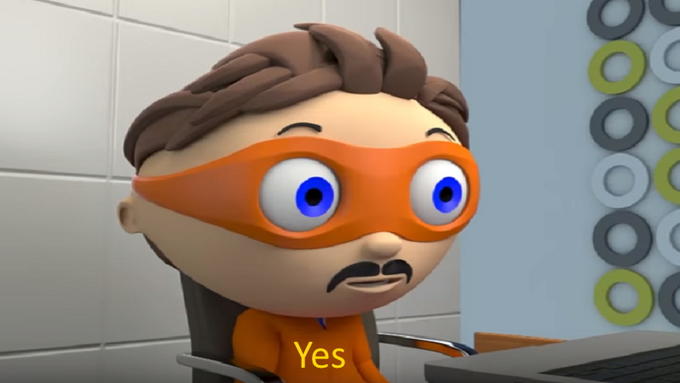
The picture shows a three-dimensional animated hero in an orange suit. An orange mask covers the upper part of his face, and from beneath it look enormous round blue eyes; above them is brown hair combed to the side, and beneath his nose is a dark mustache. He sits in an office chair in front of a laptop; in the background are a light tiled wall and a panel with colored rings. At the bottom, “Yes” is written in yellow letters. His gaze is serious and slightly bewildered, and it is this combination that makes the answer funny: the hero replies as if he had said something exhaustive.
Where the character comes from
According to English-language discussions of the meme, the frame is taken from an advertisement for the Protegent antivirus, released by the Indian company Unistal; the commercial is dated to 2016. According to these reports, the plot there is simple: the hero's computer breaks, he loses data, but the installed antivirus saves him, while the brand mascot named Proto recommends the product. The meme has no real connection to the commercial itself: only one expressive frame was taken from the ad.
The template became noticeable in August 2019, when this frame with the single word “Yes” was posted on Reddit and the post quickly gathered tens of thousands of upvotes. The picture then spread across English-language social networks, and later to Russian-language communities, where it is captioned in English or left as it is.
Why “yes” is funnier than it seems
The main mechanic of the meme: “yes” answers a question that is not answered that way. If you ask “which option is better, the first or the second?”, a normal answer names one of them. The hero says “yes,” and it turns out that both suit, or neither suits, or everything at once. That is why the template often means “a lot,” “all,” or “both.”
The second source of humor is intonation. Wide-open eyes and a calm face create the impression that the hero is completely certain his answer is correct. The more absurd the question, the stronger the contrast between the serious look and the meaningless “yes.” The joke works even better when the question is written without a catch, and the catch appears only in the answer.
Examples of captions
“How many tabs do I have open in my browser? — Yes.” A question about a number, and the answer is not a number: there are too many tabs to name a figure.
“Coffee or tea? — Yes.” The hero refuses to choose, which is familiar to anyone who takes both in the morning.
“Do you have plans for the weekend? — Yes.” The word “plans” is not specified, and the viewer understands that what is meant is the couch and a series.
“Should I work out or go to bed? — Yes.” Both actions are declared correct, and neither of them will be carried out.
How to use the template
The template works best in a “question — answer” pair, where the question contains a choice (“or”) or a request to name a quantity. It is better to phrase the question neutrally and briefly, leaving the whole joke to “Yes” itself. If the question is too long, the pause before the answer is lost.
Do not caption the frame as a real quote from anyone or as an ad for a real antivirus: the meme has nothing to do with that, and everything else remains an ordinary game of the format. It is enough to keep the yellow lettering and add a question to which “yes” becomes the most honest and the most useless answer.