Tension as a game variable
Detroit: Become Human came out in May 2018. In one of the early chapters, Connor interrogates an android accused of killing its owner. The player chooses the questions and the approach, watches the interviewee’s state, and tries to get a confession without pushing them to a critical point. An official PlayStation video featuring actor Bryan Dechart and director David Cage broke down this scene shortly after the game’s release and stressed that the conversation can unfold in different ways. Memes with the stress meter appeared in early August 2018; the well-known early variants trace back to Tumblr and Twitter, and the image was then adopted as a scale of everyday tension.
How a game indicator ended up on Connor's face
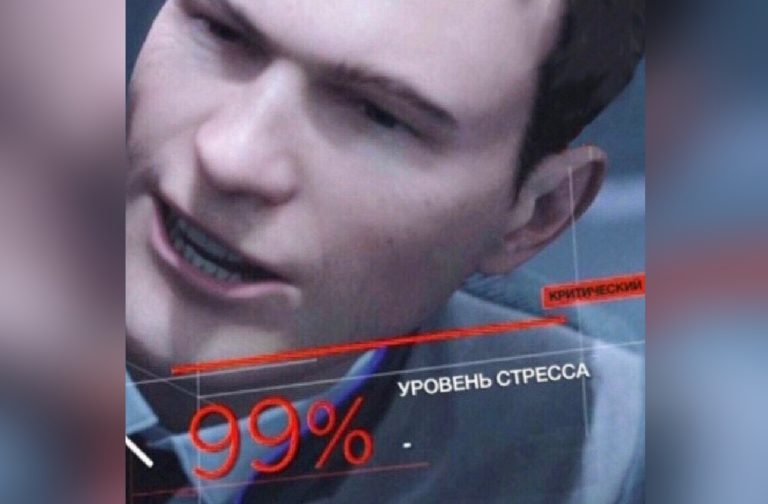
In the game, the meter refers to the interrogated android: Connor asks the questions, and the player watches the interviewee’s tension. In this picture the device has been altered. Over a close-up of Connor himself are laid a red scale, a value of 99%, and a “critical” marker. This is a meme edit, not the original interrogation screen. It transfers the game indicator onto a familiar face and lets you imagine that the one running the conversation is himself close to the limit.
The number gives the emotion the look of a measurable reading. Instead of a vague “I’m already tired,” the picture offers a precise, if playful, countdown to a breakdown. Only one percent remains before 100: that gap turns tension into a brief wait for the last irritant. The facial expression and the red marker together set the alarm, although in the game itself this value is not measured for Connor.
From interrogation to everyday overheating
The game ties the number to a choice: you must find the right tone and the right questions to get an answer. In an everyday meme, this task shrinks to a recognizable contradiction — a person wants to stay calm even though those around keep adding to the load. The scene can also be read as a joke about watching the meter itself: the player follows the number so closely that it becomes a separate source of anxiety. But the meme template usually leaves the game’s consequences out of frame and carries over only the visual indicator. It does not mean that every high-tension conversation will end the same way; in the game, the outcome depended on the player’s actions. Thus the numeric scale simultaneously promises control and shows how little room is left for error. A viewer may recognize themselves in the player who is careful with every question, or in the person who is already being asked too many questions. The combination of these roles lets the same frame serve both for anxiety and for self-irony.
Invented captions
Invented caption: “Said I could calmly wait for the repairman, and he has moved the visit for the third time.” An almost full meter turns the very attempt not to show irritation into a joke. Another version: “On the call they asked me to open a file that was sent in five different chats.” Here the indicator signals not anger at a specific colleague, but accumulated fatigue from chaos. Finally: “A relative asks me to explain the router password over the phone while standing right next to the router.” The situation makes the tension funny through the repeated explanation. All captions are fictional; they are not lines from the game or words of an actor.