What Coffey said to Paul
The Green Mile, based on Stephen King's novel, was directed by Frank Darabont; the film came out in 1999. Michael Clarke Duncan plays John Coffey, a prisoner with an unusual gift, and Tom Hanks plays prison guard Paul Edgecomb. Before the execution, Coffey talks with Paul and admits to being tired of loneliness, others' cruelty, and pain. He addresses Paul, a man who sympathizes with him but is responsible for carrying out the sentence.
In 2018, a frame with the short Russian line spread on VKontakte, including in meme communities such as MDK. By early June, a notable wave of everyday captions already existed. In 2021 the format gained fresh popularity on Reddit in the English version I'm Tired, Boss. The film's release year and the dates of these waves mark different stages: the emotional scene existed long before it turned into an everyday reaction.
A face instead of a long answer
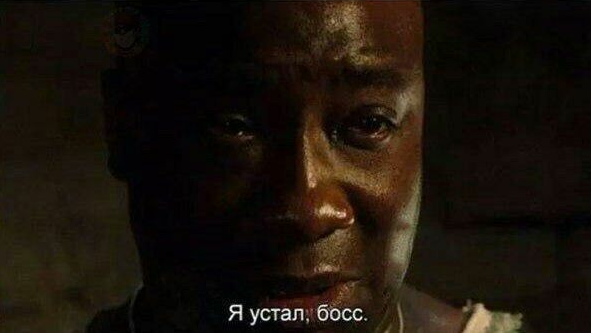
The image shows Coffey's face in close-up. One side is lit more strongly, the other fades into darkness; his eyes are moist, his gaze directed at his interlocutor. At the bottom is the white caption “I'm tired, boss.” Paul is not visible in this frame, nor is most of the surrounding space. Such a tight composition draws attention to the face and the printed words, without distraction from the details of the prison interior.
The force of the reaction comes from the mismatch between the hero's outward scale and his vulnerability. The viewer sees a large, physically strong man speaking about the limit of his strength. So even without knowing the whole film, the exhaustion seems final and the request serious. In the meme caption, the interlocutor can be a boss, a friend, a homework assignment, or the schedule itself. The ready-made line lets you answer them without changing your expression or adding a long dialogue.
Why a small task gets big drama
The everyday joke usually starts with repetition: the person has already done a lot, and yet is expected to do one more thing. The frame appears at the moment when a calm explanation seems too weak. One extra question after a long conversation, or a new request after cleaning up, gets a reply with the emotional weight of a dramatic film. The disproportion between the occasion and the facial expression produces a comic effect while preserving the understandable wish to stop.
A meme can convey both literal exhaustion and irritation at an endless process. The word “boss” turns the source of the burden into the one you must obey: even a broken appliance seems to issue yet another assignment. The reaction does not necessarily demand surrender, though. Sometimes it is a friendly exaggeration, after which the person still does what was asked. The difference between Coffey's tragic context and a new everyday event remains the basis of the joke, regardless of how hard the day actually was.
Three invented final requests
First invented example: the host of a family photo shoot has already taken thirty pictures, but someone asks again, “one more, only everyone looking at the camera.” Coffey's frame becomes the photographer's reply to an attempt to endlessly improve a single result. In a second invented variant, a person assembled furniture, removed the packaging, and sat down to rest, while the family chat asks whether they could quickly move the wardrobe to another wall. The key moment turns out to be the one after the announced end of work.
Third invented scenario: a musician rehearsed a difficult passage ten times, and the recording of the last successful take was not saved. The caption “The program suggests trying again” gives the technology the role of a strict interlocutor. In these examples the exhaustion has different causes: someone else's perfectionism, a new task, and a technical failure. But the answer is equally brief. Coffey's face replaces an explanation of why one more small request now feels far heavier than it would have looked at the start of the day.