What's visible in the frame
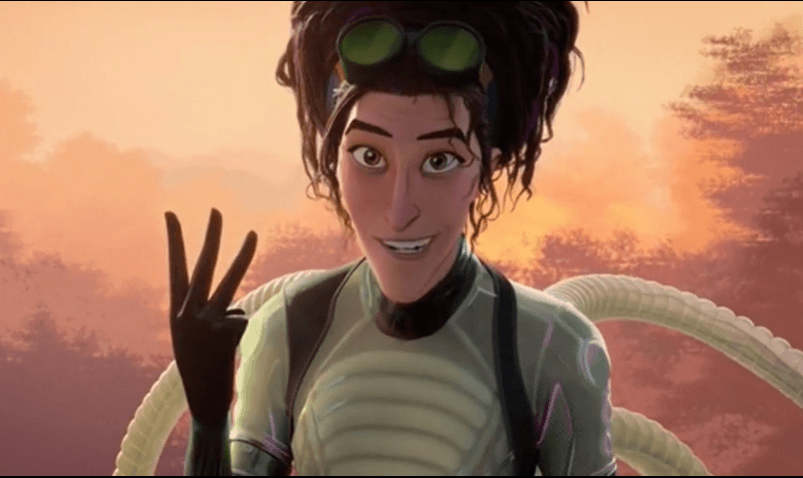
The heroine is the female version of Doctor Octopus, Olivia Octavius. Her thick dark hair is gathered in a careless bun, and greenish protective glasses are pushed up on her forehead. She wears a light green suit with ribs across the chest, and long mechanical tentacles are visible behind her back. The background is a dawn or dusk sky with orange-pink and crimson trees. One hand in a black glove is raised, fingers spread, her face is friendly with a sly smile, and her eyes look into the camera.
The expression matters more than the gesture: a person who seems to gently correct an interlocutor while clearly enjoying the moment. This slight air of superiority is what turned the frame into a ready-made line.
Where the phrase comes from
Olivia Octavius appears in the animated film “Spider-Man: Into the Spider-Verse,” released at the end of 2018. According to Russian-language descriptions of the meme, the line “Их три, вообще-то” (roughly “Actually, there are three”) is heard in the Russian version of the film: the heroine pedantically specifies the number while accompanying her words with a gesture. The exact scene and the verbatim original text remain unconfirmed, and differences between the dub and the original are possible.
The film gained wide recognition and awards, and Olivia's light, slightly coquettish image quickly spread through screenshots and reactions. As a standalone meme the frame exists independently of the plot: a viewer does not need to remember who Spider-Man is to get the intonation.
How the joke works
The joke is built on a minor correction delivered with great self-assurance. An interlocutor names a number, a list, or a version, and in response comes a picture with fingers and a smile: “Hold on, that's not right.” The less serious the topic and the more confident the pose, the funnier it is. If the correction concerns something important, the meme turns into nitpicking and loses its lightness.
Another layer appears when the number in the caption does not match the number of fingers. Then the joke becomes double: the correction itself contains an error. This device works well in a circle where the meme is well known.
The template also works in chats where people like to argue over details: in discussions about counts, versions, or number of episodes. As long as the caption is short and the number is stated confidently, the picture looks like a gentle but triumphant reply.
Examples for your own caption
“— Our team has two developers. — Actually, there are three. (I forgot that I'm one too)” — self-irony: a person counts their own place on the team.
“Friends say I have two cats. Actually, there are three. The third lives in the stairwell, but he's ours” — a correction that works for tenderness.
“They ask how many seasons the show has. Actually, there are three (we don't talk about the fourth)” — a correction for fans.
“How many tasks are left before the deadline? Actually, there are three. They're just very big” — embellishing the count.
How to use the template
The meme works best in a dialogue where someone has already said an inaccurate number. It is good because it corrects without aggression: a friendly look softens the sharpness. It is not suitable for arguments about serious matters, where a correction can sound like mockery of a person. The image is large enough that the gesture is readable even in a small preview, and the bright orange background helps the picture stand out among others.
A good caption rests on two lines: someone's inaccuracy and a reply with the picture. If you add a third element, such as an excuse, the pause on which the whole joke depends disappears.