What's shown in the frame
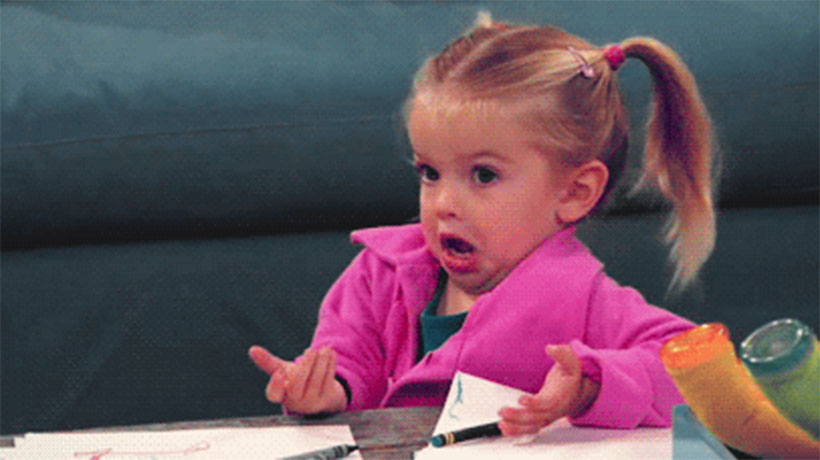
In the center of the frame is a little girl in a pink zip-up top, with a high ponytail on the back of her head and a pink hair tie. She's sitting at a table on which sheets of paper and pencils are scattered. Her hands are raised, palms facing outward, as if she's trying to explain something or shield herself from someone's words.
The main thing in the image is her face. The girl has her mouth wide open, her eyebrows raised, her gaze directed to the side, and her expression reads as surprise, hurt, and a desire to object, all at once. This kind of expression is understandable without any context, which is why the shot suits almost any argument or awkward situation.
Backstory of its origin
The meme is taken from the American sitcom "Good Luck Charlie," which premiered in 2010. The girl in the shot is played by actress Mia Talerico, born in 2008 in California. According to one publication, she was about eleven months old at the time of filming, and her parents, who work in television, kept the baby entertained with toys.
The episode the shot is taken from wasn't conceived as a meme scene: it's a natural reaction from a small child to what was happening around her. That's exactly why the expression came out so vivid and spontaneous. The series ended in 2014, and Talerico herself grew up and returned to acting, appearing in a short film and a horror movie. In interviews she's treated the popularity of her image with humor.
How the meme is used
A typical caption appears under a remark that seems outrageous, absurd, or unexpected. For example, when a boss announces that the weekend is canceled, or when someone in a chat suggests redoing a piece of work from scratch. In this context the girl acts as a mirror: her face says more than any text could.
In the Russian-language internet, the meme is most often accompanied by short phrases like "Are you serious?," "What just happened?," or "No thanks, I'll pass." Sometimes the shot is used to describe one's own state, for example after a failed answer on an exam or upon hearing unpleasant news. This device makes the reaction self-deprecating and helps the person laugh about the situation along with their interlocutor.
Why the meme caught on
The meme works because the emotion on the face is understandable without translation. Shock, indignation, and confusion merge into a single expression, and anyone can project their own story onto it. The shot also looks very natural: there's no pose or obvious staging, which means it lacks the sense of fakeness that often gets in the way of reaction pictures.
Over the years interest in the meme has somewhat faded, but the image keeps steadily returning in messaging, comments, and compilations. It has become established as one of the basic reactions to absurdity and has turned into a visual signal understood without a caption: just seeing the raised palms and the wide-open mouth is enough to guess that the speaker is horrified by what they've just heard. The image itself is also often discussed in the media as an example of how a random shot from a children's show turns into a universal language of emotion, understood by people of different generations and countries.